

Two of the country’s five commercial banks changed hands in the same eighteen months, and neither change was really about competition. One was the government buying its own dominant bank back from a foreign shareholder. The other was a New York-backed platform buying the next one down. Read together, with a regional capital deadline landing on every bank in the country at once, this isn’t a story about Equatorial Guinea’s banking sector opening up. It’s a story about who gets to survive a squeeze that has nothing to do with Equatorial Guinea at all.
The State’s Bank
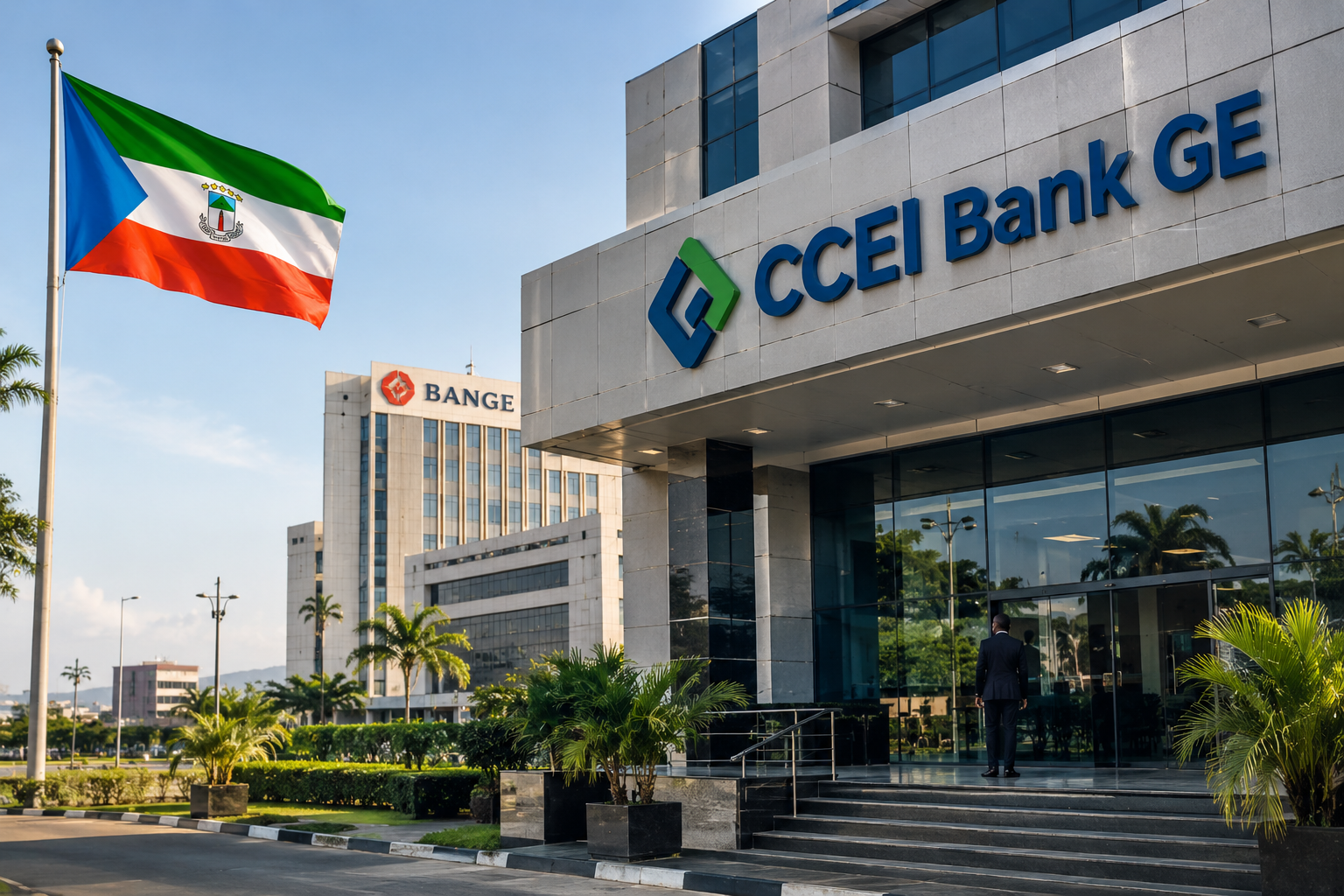
Start with the biggest one. CCEI Bank GE, which holds roughly half of the country’s total banking assets, was a subsidiary of Cameroon’s Afriland First Group until July 2020, when the Republic of Equatorial Guinea bought out Afriland’s combined 66% stake and took majority control. Capmad’s reporting on the takeover frames the state’s rationale directly: the operation aimed to regain control of an institution facing governance difficulties and a demanding regulatory environment. What followed was a restructuring under COBAC’s prudential oversight, and by 2025 it had paid off in a way that’s genuinely notable — CCEI Bank GE tripled its net profit for the year, recovering its own reporting frames as a state-led turnaround.
That matters beyond the balance sheet. CCEI Bank GE and the state-owned BANGE — which runs the country’s dominant mobile-money service, Muni — are now, between them, the two majority state-controlled pillars of a five-bank system. For a country of roughly 1.8 million people, most of the domestic savings intermediation and credit financing in Equatorial Guinea now runs through institutions the government directly controls.
The American Money
The second ownership change moved in the opposite direction. Société Générale, as part of its broader exit from African markets, sold its 57.2% stake in SGBGE — historically the country’s number-two bank — to Vista Bank Group, a Burkinabè-registered pan-African banking platform backed by the New York investment firm Lilium Capital. The deal was signed in June 2023 and finally closed on May 8, 2026, with Equatorial Guinea’s vice president Teddy Nguema Obiang announcing the completion directly, describing Vista as a pan-African banking platform tied to American capital and expanding across the continent. The bank has since been renamed Banque Générale de Guinée Équatoriale. Vista tied the acquisition to a headline commitment: $10 billion over ten years, aimed at infrastructure and small and medium-sized enterprise financing — a striking figure to attach to an economy where non-oil private investment has averaged only around 5% of GDP for decades.
There’s a procedural detail here worth flagging plainly rather than passing over. According to the CEMAC Commission’s own published competition notice, the Vista–SGBGE transaction wasn’t formally notified to the regional competition regulator until June 24, 2026 — roughly seven weeks after Equatorial Guinea’s own authorities had already announced the deal as closed. The Commission’s review only opened on August 11, 2026. That’s not evidence of wrongdoing on anyone’s part; regional notification timelines and national closing announcements don’t always move in lockstep. But it does mean a deal reshaping ownership of the country’s second-largest bank was publicly declared done before the region’s own competition watchdog had formally started looking at it, which is worth readers knowing plainly.
The Deadline Nobody In Malabo Set
Both ownership changes are landing right as every bank in the country faces the same regulatory clock, set entirely outside Equatorial Guinea’s borders. Under COBAC Regulation R-2025/02, adopted December 10, 2025, the minimum share capital required of any bank operating across the six-country CEMAC region rose from CFA10 billion to CFA25 billion effective January 1, 2026, with compliance plans due by June 30, 2026. Ecobank Guinée Equatoriale has already published its roadmap — CFA16 billion by the end of 2026, CFA21 billion in 2027, reaching CFA25 billion by financing the increase through retained earnings rather than new shareholder contributions. Board chairman Estanislao Don Malavo told shareholders directly that the plan would “strengthen the bank’s financial resilience, reinforce compliance with prudential banking standards and expand its ability to finance businesses, entrepreneurs and strategic development projects.”
The regional numbers behind that deadline explain why COBAC moved. A 2024 CEMAC multilateral surveillance report found ten banks across the bloc, five of them in Chad, carrying a combined net capital shortfall of CFA247.3 billion — roughly $442.5 million — with 22 of the region’s 56 banks failing to meet all capital prudential standards that year. Equatorial Guinea’s own numbers sit inside that same story: the IMF’s July 2025 Article IV consultation found the country’s banking sector “showing clear signs of improvement in 2024” while still describing it, in the same sentence, as “undercapitalized.” The same report notes, separately, that Equatoguinean authorities decided not to publish asset declarations of public officials, despite what the Fund calls a longstanding commitment to do so — a governance detail that sits uncomfortably next to a banking sector regulators are simultaneously calling improved.
Two Banks, One Filter
Put the three threads next to each other and the pattern isn’t competition returning to a five-bank market. It’s a filter. COBAC’s capital deadline doesn’t ask which bank has the best loan book or the most efficient balance sheet — it asks which bank has a shareholder able to write a check for CFA25 billion by mid-2027. CCEI Bank GE has one: the Equatoguinean treasury, which just proved it’s willing to spend on a turnaround. BGGE, the renamed SGBGE, has one too: Lilium Capital, backing a platform that’s already put a $10 billion figure on the table. The banks without a deep-pocketed backer — BGFIBank’s local subsidiary, Ecobank GE financing its own increase out of retained earnings rather than a shareholder infusion — are the ones actually having to prove, quarter by quarter, that they can grow into the new requirement rather than simply have it written on demand.
That’s the risk actually worth tracking, and it isn’t which bank fails the capital test. A rule meant to make CEMAC’s banking system safer is, in Equatorial Guinea’s case, doing the opposite of what diversification would require — collapsing a five-bank market toward two deep-pocketed backers instead of spreading risk across more of them.
