


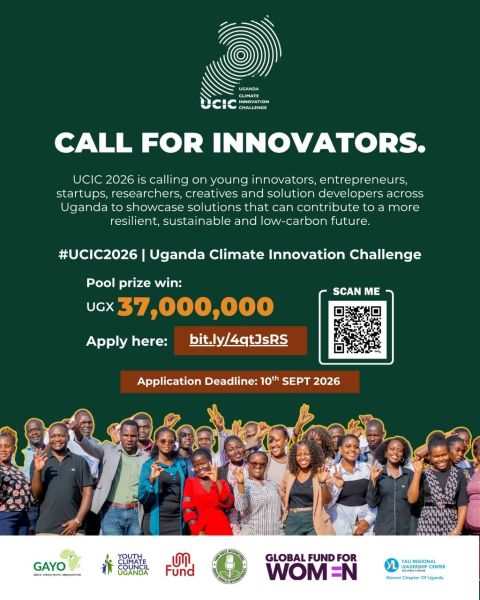
Uganda’s young climate innovators are being invited to apply for the Uganda Climate Innovation Challenge (UCIC) 2026, a national program designed to identify, develop, and finance emerging climate solutions.
The initiative targets young innovators, startups, researchers, entrepreneurs, creatives, technology developers, and community-based solution builders working across Uganda.
UCIC will focus on five areas:
- Climate art and storytelling
- Circular economy
- Clean energy innovation
- E-mobility
- Circular regenerative agriculture
The program is designed to move promising ideas beyond innovation into commercially viable and investment-ready enterprises. The concept note identifies limited access to finance, mentorship, incubation, and markets as some of the barriers facing young climate innovators in Uganda.
What selected innovators receive
UCIC plans to:
- Train 100 innovators virtually
- Select 20 enterprises for intensive incubation
- Award the six best entrepreneurs from a shared UGX 37 million micro-grant pool
- Connect innovators with investors, government, academia, and development partners
- Provide mentorship, legal and intellectual-property advisory support, and market-development assistance during incubation.
The program expects to attract more than 1,000 applications, creating a pipeline of youth-led climate enterprises that can potentially move toward investment and scale.
Who can apply?
Applicants must generally be 18–30 years old, be Ugandan citizens or eligible residents in Uganda, and be founders, co-founders, or key decision-makers in their initiatives.
The enterprise must be based in or primarily operate in Uganda. Startups should have at least developed a minimum viable product (MVP), while existing enterprises should have an identifiable product or service and customers or beneficiaries.
Why it matters for Uganda’s capital pipeline
The interesting part of UCIC is not only the micro-grant.
Its stated ambition is to build a pipeline of investment-ready climate enterprises and strengthen connections between innovators and capital providers. The program also proposes longer-term mechanisms, including climate innovation hubs, a climate investment facility, and private-sector partnerships.
That makes UCIC part of a broader question facing African climate innovation: how do promising locally developed solutions move from ideas and prototypes into businesses capable of attracting capital and scaling?
Application deadline: 10 September 2026
Apply: Uganda Climate Innovation Challenge 2026 Application Form
