

The New Kid: Six Funders, One Loop, Zero Chill
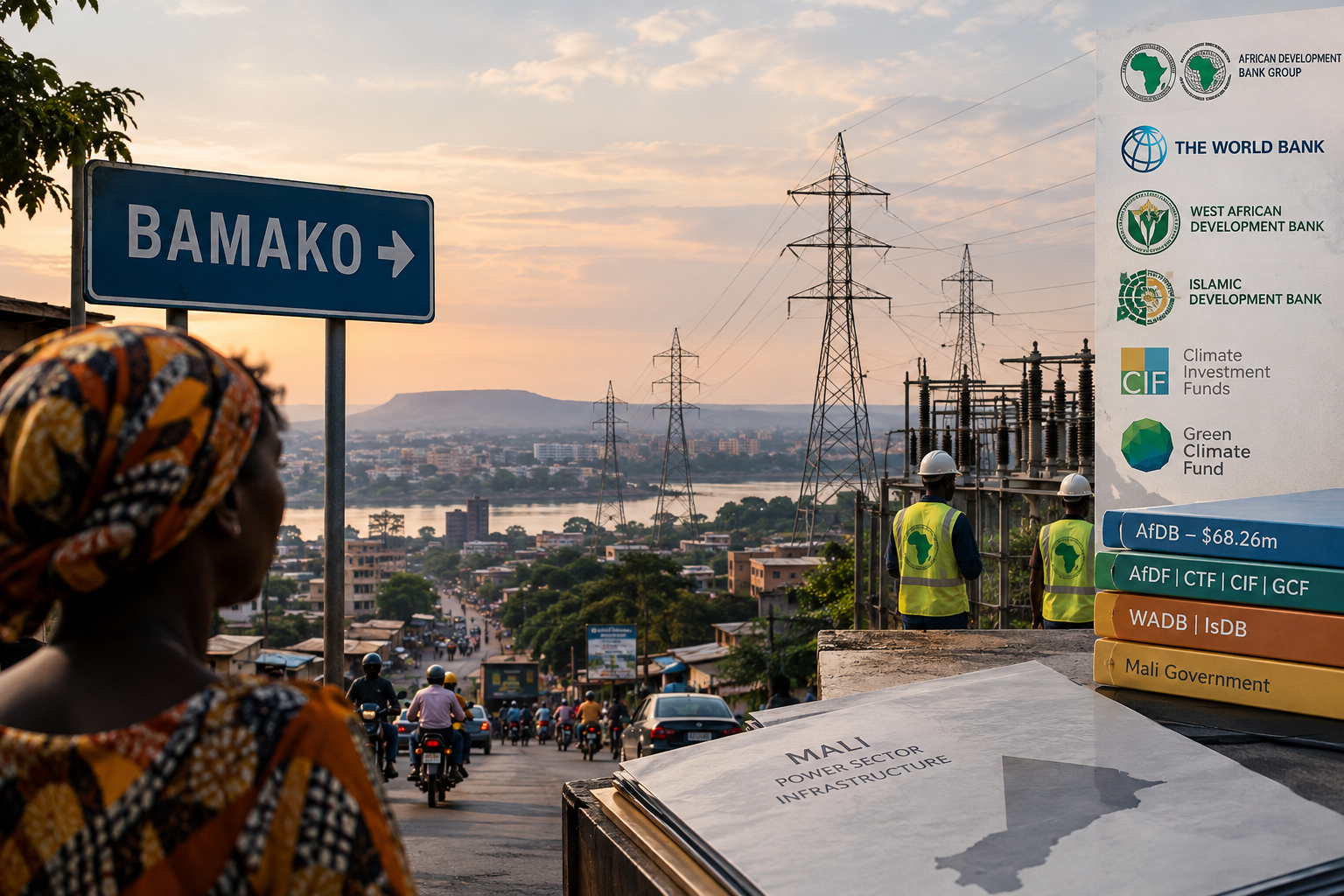
On 12 November 2025, AfDB’s Board approved $68.26 million toward Mali’s Bamako North 225 kV Loop Project, a $190 million effort to modernise the transmission and distribution network feeding the capital, connect roughly 10,000 new households and small businesses, and improve supply for about 40 industrial sites currently surviving on hope and diesel generators.
AfDB’s own contribution, roughly 36% of the total, runs through four channels: its concessional African Development Fund, its Transition Support Facility (discussed below), the Climate Investment Fund, and the Green Climate Fund. The West African Development Bank and the Islamic Development Bank split most of the rest, with Mali’s government covering a small remainder. Six institutions on one transmission loop.
Mali’s National Transitional Council ratified the loan agreements this year. Worth saying plainly rather than skating past: that’s the country’s military-appointed legislature, not an elected parliament. Construction is set to start in the third quarter of 2026, with the project scheduled to run through December 2030.
Read the Fine Print: “Transition Support Facility” Is Doing A Lot Of Quiet Talking
Most of the coverage of this deal treats “Transition Support Facility” as just another line item in an alphabet soup of DFI acronyms. It isn’t. AfDB’s Transition Support Facility exists specifically for fragile and conflict-affected states — countries the Bank has formally decided need softer terms and closer handling because the usual assumptions about institutional stability don’t hold.
Mali qualifying for it isn’t a footnote. It’s AfDB, in its own internal risk language, quietly confirming what everyone already knows about lending into a country currently run by a transitional military government: the money comes with an asterisk, even when the asterisk is spelled out in acronyms instead of plain English.
Meanwhile, Across Town: The Sequel Nobody Asked For
Here’s the part that turns this from a nice infrastructure story into an actually interesting one. Bamako already has a DFI-funded power project underway: the World Bank-backed Mali Electricity Sector Improvement Project (MESIP), approved by the Bank’s Board on 21 June 2019 and made effective in January 2020, with $150 million in IDA financing against a total project cost of $152.1 million. The World Bank’s own restructuring paper on the project confirms the closing date has been pushed to 31 July 2026, and cites Mali’s “challenging financial situation” as part of the reason. On 30 June 2026, Mali’s Council of Ministers ratified an additional $35 million IDA top-up, CFAF 19.7 billion, after implementation studies found the project needed roughly $74 million more than planned for line construction, substation upgrades, and distribution network extensions, raising total World Bank financing to $185 million.
That same World Bank restructuring paper, worth flagging directly, names the Bamako North project by its own accord: it references “the Bamako Boucle Nord Project for which the GoM just closed the €137.11 million financing with the African Development Bank approval of its €37 million contribution on November 12, 2025.” The Bank writing its own struggling project’s restructuring paper while name-checking the newer one landing a few kilometres away is about as close as two separate DFI-funded soap operas get to acknowledging they’re filming in the same city.
Read the two projects side by side and the pattern is hard to miss. A nearly identical earlier attempt at fixing the same city’s same electricity problem is still asking for spare change to finish, seven years after approval and well past its original closing date. The newer project’s ink is barely dry.
The Actual Question This Desk Is Asking
Different funders, different scope, a different decade of Mali’s political situation. None of that guarantees Bamako North avoids MESIP’s fate. What it does mean is there’s now a specific, checkable precedent sitting in the same city, in the same sector, financed by an institution that wrote its own paper trail on exactly what went wrong the last time.
The real test isn’t whether six institutions and a fragile-states risk instrument sound more reassuring than the World Bank’s original single-source IDA credit did in 2019. It’s whether that broader capital stack actually buys tighter implementation discipline, or just spreads the same execution risk MESIP already priced across more balance sheets. Mali’s own Council of Ministers will be the first to find out, the next time a cost estimate comes back higher than planned. Whether AfDB’s structure holds up better than the World Bank’s did is a question with a real answer, due sometime before 2030.
