

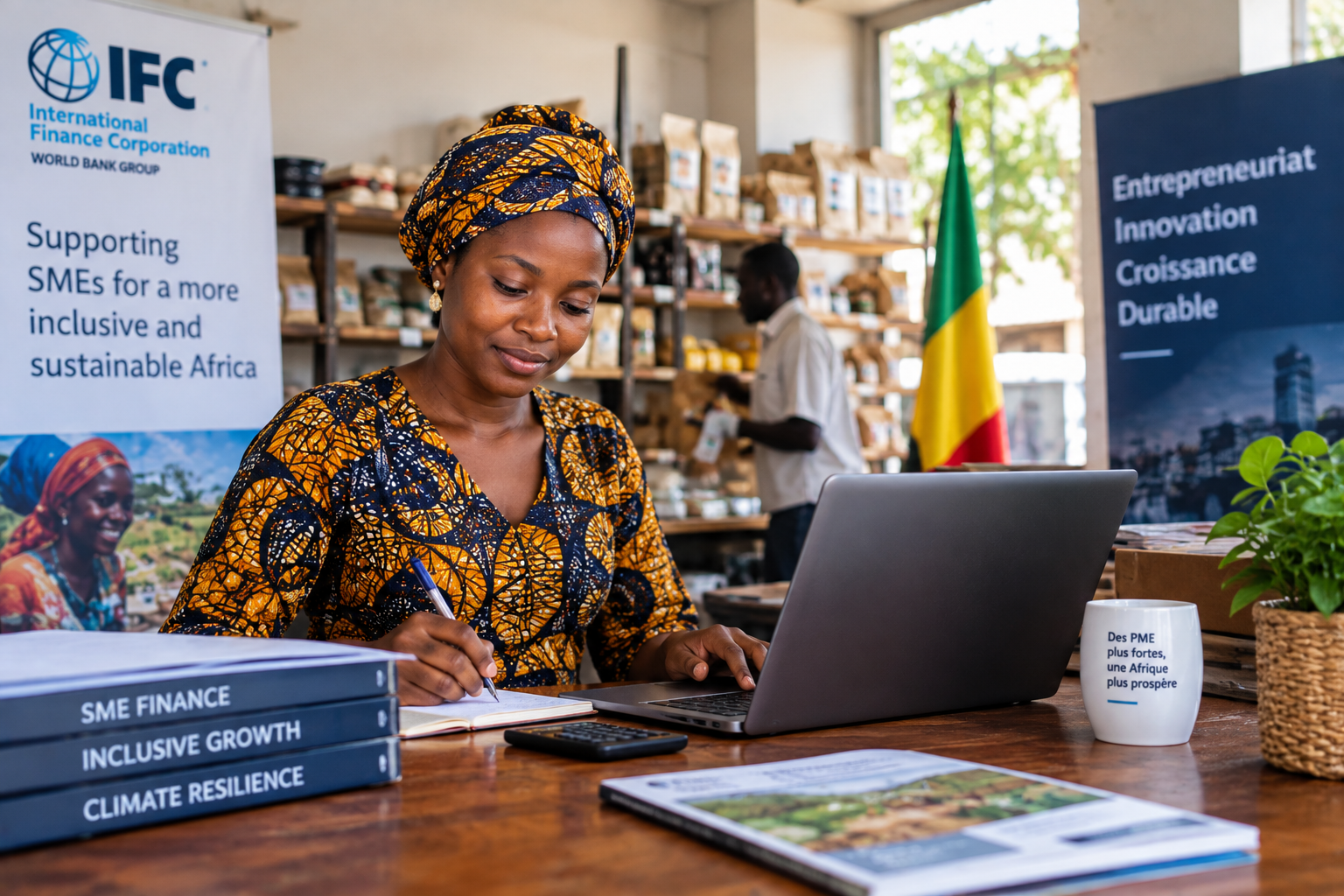
Mali’s small businesses do not appear to have a simple money problem. They have a risk problem. The country has 14 licensed commercial banks that supply an estimated 80% of private-sector financing, according to the U.S. Department of Commerce’s Mali agricultural-sector guide, yet SME lending accounts for only around 15% of bank credit and agriculture just 10% of bank portfolios. Meanwhile, Malian banks reject roughly 60% of SME loan applications.
The World Bank’s 2024 Mali Enterprise Survey, covering 392 formal private-sector establishments, gives a more rigorously sourced version of the same picture. Among firms surveyed, 35.5% named access to finance as their single biggest obstacle to operating, narrowly ahead of electricity at 31.4% and well ahead of political instability at 5.4%. Asked to rate the severity of the finance constraint specifically, 54.6% called it a major or very severe obstacle. That statistic describes formal firms with five or more employees responding to a survey about perceived obstacles—not Mali’s entire SME universe, and not a hard measure of credit denial.
Read carefully, it says something narrower and arguably more useful: among the businesses formal enough to be surveyed, finance is not a marginal complaint. It is the leading one. The survey also complicates the simplest version of the story. Among firms that did not apply for a loan, 38.8% said they simply didn’t need one—a reminder that ‘SMEs can’t get credit’ and ‘SMEs don’t all want debt’ are different claims.
But among firms that did seek financing and ran into trouble, the obstacles clustered around collateral (13.3% cited requirements as too high), application complexity (12.5%), and unfavorable interest rates (11.1%). This is not, in other words, primarily a story about insufficient money circulating in Mali’s financial system. It is a story about who is willing to underwrite the risk that sits between that money and the businesses that want it.
The $3 million that reveals a bigger machine
In June 2026, IFC approved a US$3.02 million equivalent, XOF-denominated senior unsecured loan to Baobab Mali—a three-year facility with a one-year grace period, proceeds earmarked exclusively for MSMEs, with at least 25% directed to women-owned or women-led businesses and 25% targeted at climate-related financing on a best-efforts basis.
Baobab Mali, a BCEAO-regulated microfinance institution established in 2013, is easy to mistake for the point of this story. It isn’t. The businesses actually getting funded here never touch IFC directly. Baobab, wholly owned by Baobab Group (itself owned by Beltone Capital, a Beltone Holding subsidiary), is the pass-through. IFC lends to Baobab. Baobab lends to Malian MSMEs. Two hops, not one, and the second hop is where all the actual credit judgment happens.
Then there’s one sentence in IFC’s own project disclosure that does. The Baobab Mali project, it says, is expected to sit within IFC’s MSME Finance Platform, backed by up to US$40 million in guarantees from the IDA Private Sector Window’s Blended Finance Facility. And then, in language closer to an admission than a disclosure: without that concessional support, projects under the platform would not be bankable given the challenging risk environment.
Follow the risk.
I keep wanting to write that $40 million flowed into Mali. But it didn’t, and the distinction matters enough to slow down for. It’s the size of a guarantee—a Private First Loss Guarantee under the IDA Private Sector Window’s Blended Finance Facility—sitting behind IFC’s MSME Finance Platform, a structure that, per IFC’s own disclosures, also covers a separate $5 million facility to Baobab’s DRC subsidiary.
The $40 million covers both markets together, not Mali alone, and nothing in the public record says how much of that ceiling belongs to Mali, what share of losses it actually absorbs, or whether it’s the same instrument as the $100 million regional facility described below or a different one entirely. I’m not going to guess. That’s a real gap in the disclosure, not a detail I’m choosing to skip.
What the guarantee actually does is simpler than the name suggests. Picture Baobab about to write a loan; it’s on the fence about—risky enough that its own balance sheet flinches. The guarantee tells Baobab: if this goes bad, we absorb the first losses, up to a limit, before you do. That’s it. Baobab still has skin in the game—a first-loss guarantee isn’t a blank check—but the loan that would’ve been too risky to write is now, on the margin, writable. The risk didn’t vanish. It moved.
One facility, multiple markets
Keep this separate from the $40 million guarantee above—it’s tempting to merge them because the same two institutions are involved, but they’re different instruments. In June 2026, on the sidelines of the Africa CEO Forum in Kigali, IFC and Baobab announced a regional Risk Sharing Facility covering Senegal, Côte d’Ivoire, Burkina Faso, Mali, and the Democratic Republic of Congo.
The facility supports an aggregate financing portfolio of up to $100 million equivalent, with IFC guaranteeing roughly half of it. Baobab Group CEO Philip Sigwart called it an important milestone in Baobab’s mission to support small businesses and financial inclusion across Africa—the kind of line that goes in every signing announcement and tells you almost nothing. What matters is the arithmetic underneath it.
A 50% portfolio guarantee is not IFC lending $50 million. It means that across a shared pool of loans up to $100 million, IFC has agreed to eat roughly half of eligible losses—which, per Baobab’s own account, is meant to let the group write bigger loans over longer terms, up to five years, than its own balance sheet could otherwise stomach. Nothing about this puts $100 million into Mali’s economy tomorrow. And nobody has said how much of that $100 million ceiling, or the guarantee sitting under it, actually belongs to Mali rather than the four other markets sharing the facility.
BNDA offers a different answer to the same problem.
Here’s what surprised me: IFC didn’t run the same playbook twice. In October 2025, it put $40 million—a separate transaction from either Baobab facility—into Banque Nationale de Développement Agricole (BNDA), Mali’s state-owned agricultural bank, plus a further $10 million trade-finance facility. No guarantee this time. Just a straight senior loan.
The goal, per IFC’s own release, is to help BNDA double its MSME lending portfolio to more than $270 million over five years, reaching smallholder farmers, cooperatives, and climate-smart businesses, with at least 25% earmarked for women-owned or women-led businesses and 10% for climate-smart agriculture, renewable energy, and irrigation. IFC’s own estimate: 8,600 to 14,200 jobs over five years, and BNDA’s green-finance portfolio up by nearly 90%.
BNDA’s Managing Director, Badara Aliou Coulibaly, said the usual things a bank executive says at a signing—more support for farmers and women entrepreneurs, more digital and sustainable solutions, and stronger food security. Fine. The actual story is in what IFC chose not to do here.
There was no guarantee, because BNDA didn’t need one. It’s an established bank with its own balance sheet and its own credit infrastructure—what it actually needed was duration and expertise it didn’t have: agricultural value-chain financing, climate-finance know-how, and credit-scoring tools built for smallholders rather than corporates. Baobab’s problem was capacity. BNDA’s problem was know-how and tenor. Same country, same underlying credit gap, and IFC diagnosed it two completely different ways depending on who was sitting across the table.
Why Mali is a difficult credit territory
The IMF’s July 2026 assessment reads like two stories fighting for the same paragraph. Mali’s banking system is broadly stable, it says, and private-sector credit growth resumed in the second half of 2025—good news, stated plainly. But in the very same assessment, banks’ claims on the sovereign grew even faster, which the IMF itself flags as a strengthening sovereign-bank nexus. Those aren’t contradictory findings. They’re the same finding, looked at from two angles.
Here’s why that matters, and it’s not abstract. A bank’s balance sheet is finite—there’s only so much room on it—and government securities are sitting on that same shelf as SME loans, competing for the same space. Government debt is easier to price, easier to justify to a risk committee, and doesn’t require anyone to underwrite a microfinance borrower’s collateral. It doesn’t crowd out private lending automatically. It doesn’t have to. It just has to be the more comfortable thing to hold, and Mali’s banks are holding more of it.
The IMF’s other numbers sharpen the picture: domestic arrears of CFAF 213 billion (1.2% of GDP) and external arrears of CFAF 102.8 billion (0.7% of GDP), both as of end-2025. None of that makes any individual Malian SME a bad bet. But it goes a long way toward explaining why a guarantee-heavy architecture, rather than banks simply lending more on their own, has become the default model for getting capital to smaller businesses here. The guarantees aren’t a preference. They’re what it takes to compete with the sovereign for a seat on the balance sheet.
What development capital is actually doing
I almost wrote that IFC and IDA are absorbing risk here out of goodwill. But that’s not right, and it undersells what’s actually going on. Every one of these institutions is doing something with a specific capital logic behind it—not charity, allocation.
Take the guarantee. It lets IFC extend into markets and institutions it has judged too risky to fund on ordinary commercial terms—that’s exactly what IFC’s own would-not-be-bankable-without-concessionality language is describing, in its own words, about its own risk appetite.
Take the carve-outs. Twenty-five percent to women-owned businesses, a slice for climate finance—these aren’t ESG garnishes. IFC’s own materials describe both segments as facing financing constraints distinct from the general SME pool, and earmarking capital toward them lets IFC report measurable, attributable impact against a specific mandate, rather than a vague claim about helping small businesses in general.
Take the currency. The Baobab facility is priced in XOF, not dollars, and that’s not a courtesy either. Dollar-denominated lending against local-currency revenue creates a mismatch that can turn a perfectly good borrower into a defaulter purely because an exchange rate moved. An international institution able to lend in local currency, where Mali’s own capital markets can’t easily do that at scale, is closing a structural gap. Nobody’s being generous here. Somebody’s just noticed a problem the market wasn’t solving and built a product around it.
The uncomfortable question
Here’s the number that made me want to believe the optimistic version. A Moody’s report published September 8, 2026, found that African private-credit assets under management more than tripled between 2020 and 2025—from $1.8 billion to $5.6 billion. Still just 0.3% of an estimated $1.8 trillion global private-credit market.
Here’s the optimistic case. Guarantees and risk-sharing let Baobab and BNDA lend more, for longer, to borrowers who’d have been turned away before. If those loans perform, both institutions build a track record—the kind that eventually gets you funded on better terms without anyone else absorbing your losses first. IFC’s whole emphasis on tenor and portfolio scale is built to produce exactly that outcome, on purpose.
And here’s the case that keeps pulling me back. IFC said it itself: without concessional support, the Baobab platform’s projects would not be bankable. That’s not a hedge; it’s an admission—that ordinary commercial risk appetite, including Mali’s own banks, increasingly busy holding sovereign debt instead of private loans, is not pricing this risk on its own. And if every hard segment of Mali’s SME market needs a guarantee before anyone will touch it, that’s not evidence the market is warming up. It’s evidence the market still can’t do this without help. Mali’s SME credit isn’t obviously running because of development capital and alongside it.
What happens next?
So I’m not going to resolve it here, because the evidence doesn’t let me, and forcing an answer would be dishonest. But I know what I’ll be watching for. Do Baobab’s and BNDA’s loan books actually grow, and do defaults stay manageable while they do? Do loan terms lengthen, and do they start reaching borrowers who’d have been turned away for lack of collateral or a formal registration?
IFC’s active Mali portfolio, $493.25 million across 16 projects as of March 30, 2026, is large enough that these aren’t hypothetical questions. There will be a next transaction to check them against.
Here’s where I’ve landed, for now. Who’s taking the risk on Mali’s SMEs was never going to have a one-word answer, and it doesn’t. It’s a stack. IDA and IFC’s blended-finance mechanisms take the first loss. IFC’s own balance sheet sits above that, providing the senior money. Baobab and BNDA carry what’s left, plus the actual work of finding and vetting borrowers nobody else in this chain will ever meet.
