

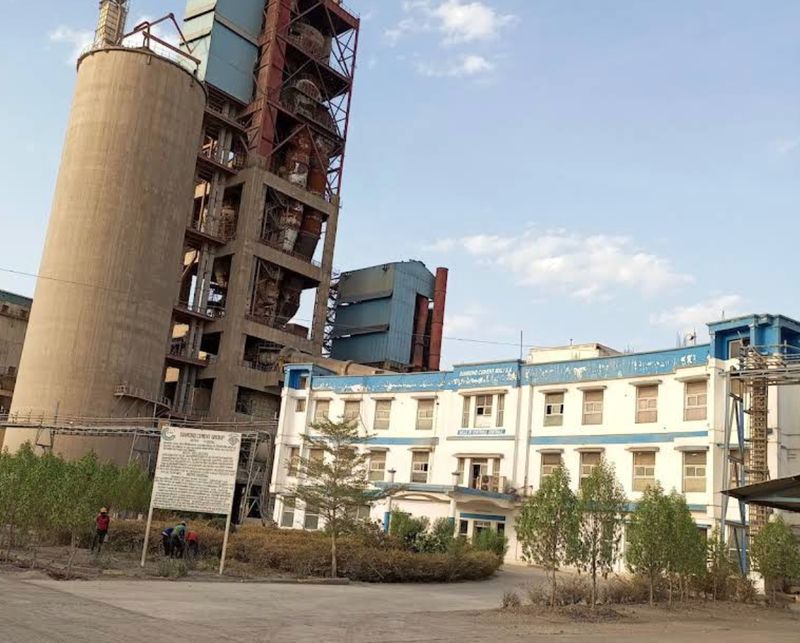
On 23 March 2026, CIMAF’s cement plant at Natien, in Mali’s Sikasso region, entered production. On 2 September, Mali’s Council of Ministers formally noted the project: a 56 billion CFA franc investment, installed capacity of 1 million tonnes a year, expandable to 3 million by 2027-28, 250 direct jobs and roughly 1,500 indirect ones.
Read as a headline, this is a standard industrialization story — foreign capital, local jobs, import substitution. Mali makes more of what it used to buy.
The headline misses the more useful number, which sits one layer down in reporting on the same project, not in the government communiqué itself: of the 56 billion FCFA, roughly 35 billion went into the factory and 21 billion into logistics and the vehicle fleet — 246 dump trucks, according to CIMAF’s own presentation to Malian officials at the site visit that preceded the Council’s readout.
That’s roughly 40 cents of every capital dollar going somewhere other than the plant that makes the product.
That ratio is the story. CIMAF isn’t underwriting a factory with a logistics afterthought. It’s underwriting a factory and a distribution network as two separate, comparably sized bets — which is itself a quiet admission that in this market, the harder problem isn’t making cement, it’s moving it.
Here’s the named example that makes the point concrete. While Natien was coming online, Gao — a city roughly 900 kilometres northeast, on the other side of the country — was living through a cement shortage. Studio Tamani reported on 22 July a tonne selling for 220,000 FCFA in Gao, against a 50kg bag at 12,000 FCFA, attributed to supply difficulties from Algeria and Niger.
Kibaru reported similar figures on 30 August — 210,000 to 215,000 FCFA a tonne, an 11,000 FCFA bag, a shortage running roughly two months. Both are clear on what these numbers are: local price observations and trader testimony, not an official national average.
And both report the same alleged cause — a halt in Nigerien cement exports north, plus difficulty on the Niger-Gao and Algeria-Gao routes — without a confirmable Nigerien government statement behind it. Treat the cause as reported, not established. The price is the harder fact; the reason for it is still an operator’s account.
Here’s what makes the contrast sharp rather than coincidental. Mali’s own Industry and Commerce Minister, Moussa Alassane Diallo, told reporters during the Natien visit that the country now has six cement plants, up from three in 2021, for total installed capacity of 5.5 million tonnes against national demand of roughly 6 million — near-parity, with self-sufficiency possible by 2027, on his account.
On paper, Mali’s capacity problem is nearly solved. In Gao, that same week, cement was scarce and expensive. Both things are true simultaneously, and the gap between them is not a production number. It’s a map.
The insight inversion: a plant in Sikasso doesn’t supply Gao by existing. It supplies Gao only if someone routes trucks there, and Natien’s 246-truck fleet, like every other producer’s logistics investment, has to be pointed somewhere — which means it can be pointed at the profitable, accessible south and simply not reach the contested, costlier north.
National capacity-versus-demand arithmetic treats a tonne of cement in Sikasso as equivalent to a tonne needed in Gao. Operationally, on the ground, those are not the same tonne. One of them has 900 kilometres, a security situation, and at least one contested border crossing between it and the customer.
That reframes the question this story is actually asking. “Does Africa have an industrialization problem?” is the wrong scale. The more precise version is: how much of what looks like a production shortfall is actually a routing and working-capital problem — fleet allocation, fuel cost, road security, cross-border friction — dressed up as a manufacturing gap because manufacturing gaps are what get funded, announced, and put in council communiqués, while logistics investment gets a subordinate clause in the same press release.
For industrial investors and DFIs, the operator implication is a due-diligence question, not a philosophical one: when a project claims “installed capacity,” ask what fraction of the capital budget went to reaching the customer versus making the product, and ask which customers specifically that logistics spend was built to reach.
A 35/21 split, as here, is a company telling you where it thinks the real bottleneck sits. Underwrite the distribution network as its own asset with its own economics, not as a rounding error on the factory.
For policymakers, the Gao contrast is the more uncomfortable lesson. A national capacity-versus-demand balance sheet that nets out at “near self-sufficient by 2027” can still coexist with a regional supply crisis, if the arithmetic doesn’t account for where the plants are relative to where the trucks can safely and economically go.
Industrial policy built purely on aggregate tonnage targets will keep producing headlines like Natien’s, and shortages like Gao’s, in the same country, in the same year.
That’s the gap this piece is really about. Not whether Mali can make cement. Whether it can move it — and whether the people funding, building, and announcing these plants are being asked that second question with the same rigor as the first.
