


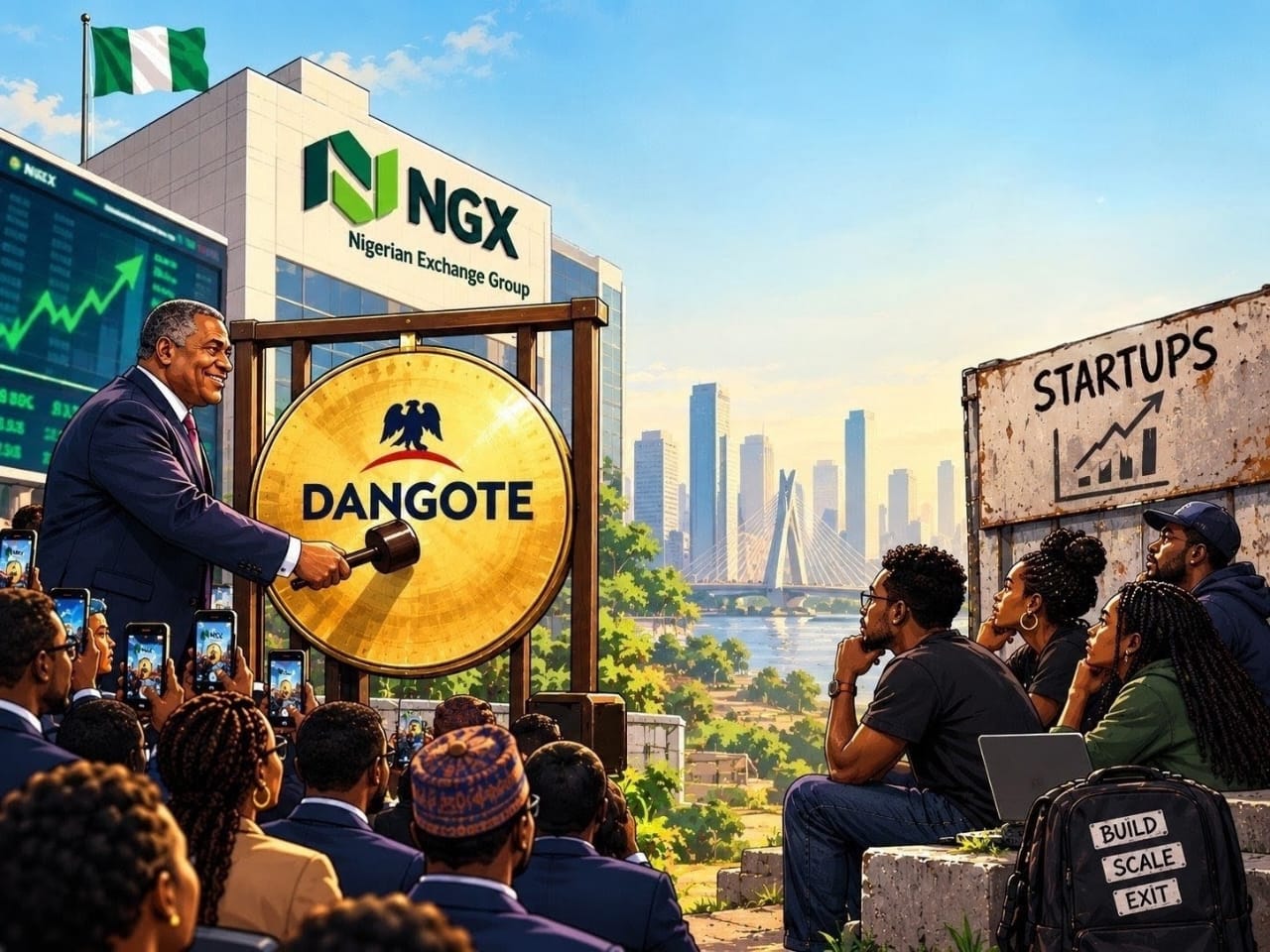
This week, the Dangote Refinery IPO opened, the WhatsApp groups are doing what WhatsApp groups do.
Screenshots of the subscription portal, jokes about Bamboo and Cowrywise crashing under retail demand, and somewhere in the noise, a version of the same question kept surfacing among the founders and fund managers I talk to: if NGX can absorb this, why can’t it absorb us?
It’s a fair question to ask. It’s the wrong question to answer with “it can.”
Three years ago, NGX launched a dedicated Technology Board built specifically to attract high-growth startups onto the exchange. In those three years, against a backdrop of Nigerian founders raising hundreds of millions of dollars from global venture capital and building companies that now contribute close to a fifth of GDP, exactly zero venture-backed technology companies have listed through it in a genuine capital-raising IPO.
Not Flutterwave. Not Moniepoint. Not one. The nearest thing to a counter-example is Aradel Holdings, the oil and gas group that joined the NGX main board in October 2024 with a ₦3 trillion valuation — but Aradel didn’t raise a naira doing it.
It came in by “listing by introduction,” moving existing shares onto the main board from the NASD OTC exchange, with no new capital changing hands and no investor cashing out.
Even the nearest domestic precedent for a fast-growing company going public locally isn’t actually an exit.
The Dangote listing didn’t happen in spite of the Technology Board’s empty record. It happened inside the same market that’s carried that empty record for three straight years — which should tell you something about how little the two events actually have in common.
Same building, different machines
Start with what the refinery IPO actually is, stripped of the ceremony.
It’s a primary capital raise by an already-profitable, already-operating industrial asset, denominated in naira, generating hard-currency earnings from jet fuel exports to Europe, with a founder who is selling roughly 3% of the business while keeping every lever of control firmly in his own hands.
The people buying in aren’t rescuing anyone’s balance sheet or providing an exit for anyone. They’re buying exposure to cash flows that already exist.
A venture-backed tech exit is a different machine entirely.
It exists to solve a specific problem: a fund raised capital from LPs with a return timeline, deployed it into a company at a paper valuation, and now needs that paper to become cash — ideally in a currency the LP can actually use. Most of the companies this applies to in Nigeria were never built to solve that problem locally.
TLP Advisory’s November 2025 report, Rethinking Funding & Exits: Nigeria’s Missing IPOs and the NGX, surveyed 36 founders and found that 77% of funded startups raise their capital in dollars while generating revenue in naira, which is precisely the mismatch that makes a Lagos listing unattractive to the investors who’d need to sign off on it.
Layer onto that the standard Delaware–London–Lagos structure most venture-backed African companies use — holding company and IP sitting offshore, Nigeria as the operating subsidiary — and you get businesses that are, on paper, foreign entities with no natural home on NGX even when nearly all their revenue is Nigerian.
Richmond Bassey, CEO of the wealthtech platform Bamboo, put his finger on the other half of the problem in blunt terms: there isn’t a lot of high-frequency trading activity on the exchange. That’s not a complaint about NGX’s ambition. It’s a description of depth — and depth is exactly what a venture exit needs and what an already-operating industrial asset, backed by decades of cash flow, needs far less of.
The refinery is the exception proving the rule
Here’s the part the celebration tends to skip past. NGX’s total equity market capitalisation stood at roughly ₦158 trillion, about $119 billion, the week the refinery IPO opened. Reports describing the Dangote listing as capable of representing “up to 40%” of that figure are measuring the refinery’s full post-listing valuation — its entire outstanding equity, once listed, not merely the roughly $1.6–2.1 billion actually being raised or the sliver Dangote is selling down — against NGX’s existing market cap.
On that basis the math holds: a ~$49 billion company landing inside a ~$119 billion exchange is a genuine structural event. But it’s worth being precise about which number is doing the work, because the 40% figure describes how much weight one already-built asset adds to the index, not how much fresh capital retail Nigerians are actually putting behind it.
Read that way, it’s less a sign of a market ready to absorb billion-dollar assets at will, and more a sign of how thin everything else on the board still is relative to one. When a single listing can mechanically shrink the combined weight of NGX’s largest blue-chip companies without a single one of them losing a naira, you’re not looking at evidence of depth. You’re looking at evidence of concentration.
That matters directly to the exit question, because a fintech unicorn considering NGX runs into the same wall from the other direction. When OPay began weighing a Lagos listing this year alongside its planned US offering, the obstacle wasn’t appetite — it was that local pension funds have limited experience pricing a fast-growing, still-unprofitable technology company the way global tech investors do.
That pricing-competency gap is arguably the single hardest obstacle in this entire discussion, harder than liquidity and harder than the currency mismatch, because it isn’t solved by a rule change.
A refinery with a 25-year operating history and physical barrels to point to is a business Nigerian institutional capital already knows how to price. A five-year-old fintech burning cash to acquire the next ten million users is not, yet — which is exactly the gap the next section is about closing.
What would actually move the needle
None of this is a case against Nigerian startups ever listing at home. It’s an argument that the Dangote IPO, for all its scale, doesn’t get us any closer to that outcome on its own — and treating it as proof of concept for tech listings risks pointing founders and funds at the wrong lesson.
The lesson that would actually transfer is structural, and TLP Advisory’s report already sketched most of it: deepen institutional participation by drawing pension funds further into pricing growth assets, not just industrial ones — closing precisely the competency gap the OPay case exposed.
Build the securities lending and market-making infrastructure that gives a thinly-traded stock room to find a real price instead of gapping on every large order.
Reduce the dollar-return dependency that pushes venture capital toward London and New York by default, rather than treating a naira listing as something investors tolerate only after the safer options are exhausted.
And be honest with founders about the actual bar — more than half the ones TLP surveyed said they didn’t fully understand the NGX listing process in the first place, which is a solvable problem, and a cheaper one to fix than market depth.
Wale Salami, the Nigerian-born venture and private capital investor, framed the ambition correctly a month before the refinery IPO ever opened: the goal isn’t an exchange that’s merely good enough for where Nigeria’s capital market is today, but one built to be a credible exit for venture-backed companies, not a frontier-market curiosity investors visit once and leave.
The Dangote listing is a genuine achievement measured against that ambition. It is not the same achievement — and treating it as one is where the confusion in the WhatsApp groups actually starts.
For VC and angel investors underwriting Nigerian and African deals with an eventual NGX listing somewhere in the return model, this week’s headlines don’t change that math, and shouldn’t yet.
The exit math for a venture portfolio still runs through dollar-denominated liquidity events, most of them offshore, and nothing about a refinery selling 3% of itself to ten million Nigerians alters that arithmetic.
For pension and institutional allocators watching the subscription numbers as a signal to widen their own risk appetite, the signal is real, but it’s a signal about pricing known industrial cash flows at scale, not about developing the muscle to price unprofitable growth companies.
Those are two different competencies, and the gap between them is where Nigeria’s actual startup exit problem still lives.
