


I see Africa’s power deficit from both sides of the financing table: as an operator developing power solutions for businesses that cannot wait for the grid, and as the head of a financing platform assessing which energy assets can carry capital without depending on optimism. That experience leads me to a less fashionable conclusion about artificial intelligence and electricity. AI will increase demand for reliable power, but demand alone will not unlock African energy investment.
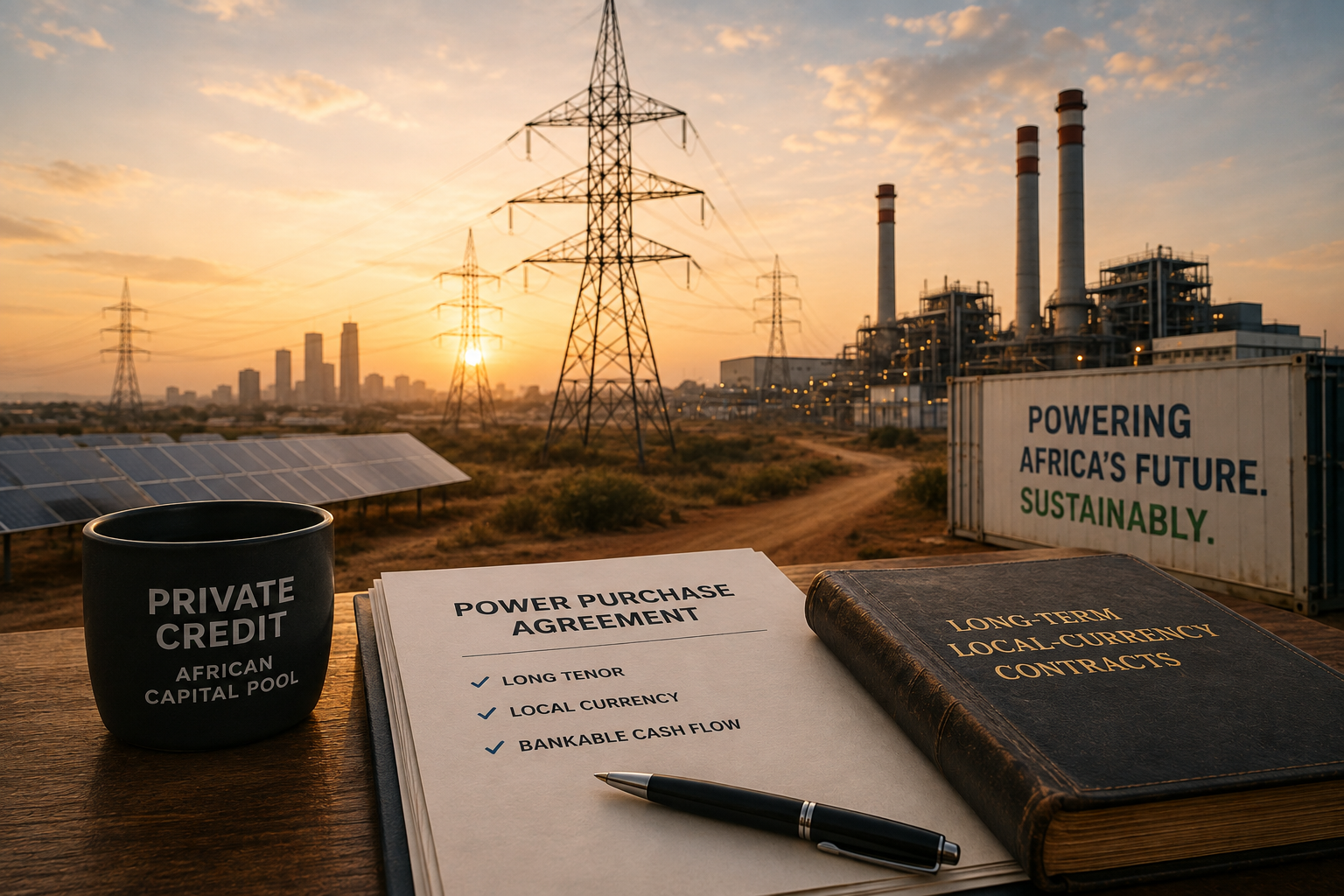
Capital moves when demand becomes a contract, the contract becomes a predictable receivable, and the receivable is protected by enforceable rights over cash and assets. For the electricity layer beneath Africa’s digital economy, private credit is closer to deployment than another broad technology or infrastructure equity fund. Its real constraint is bankable offtake: creditworthy users, long-enough contracts, enforceable payment security, and revenues aligned with the currency and tenor of the debt.
The global demand signal is unmistakable. The International Energy Agency expects data-centre electricity consumption to rise from about 485 terawatt-hours in 2025 to roughly 950 terawatt-hours in 2030, while consumption by AI-focused data centres triples. Yet Africa starts at the edge of that market: in 2024, the continent consumed less than one kilowatt-hour of data-centre electricity per person, the lowest level of any region. The question for African capital is therefore not whether AI consumes power. It is why money can finance data-centre buildings, servers and connectivity more readily than the dependable electricity on which their value depends.
Follow The Capital Already In The Room
Rack Centre provides the useful Nigerian case. In 2020, Actis acquired a controlling stake in the Lagos operator alongside Jagal. Funding for expansion came through a US$250 million pan-African data-centre platform established by Actis and Convergence Partners, and Rack Centre announced a US$100 million expansion of its Lagos campus. The sequence matters because it shows why private equity moved: a specialist operator, established enterprise and cloud demand, carrier-neutral infrastructure, an executable expansion path and the prospect of regional scale.
Capital was not underwriting a slogan about rising African data use. It was underwriting an operating platform capable of capturing that rise. But a data centre is also a concentrated power obligation. Servers, cooling systems, power-quality equipment and redundancy must operate continuously. Where the grid cannot meet that requirement, the developer has to combine grid supply, renewable generation, storage and dispatchable backup into one reliable service.
South Africa’s Teraco shows what happens when that electricity requirement is translated into financeable infrastructure. In 2024, Teraco announced an R8 billion syndicated loan, arranged through Absa and other financial institutions, to finance a new data-centre facility and related construction. Part of the facility also supported its renewable-energy programme, including a 120MW solar plant in the Free State. Teraco reported that the syndication was well oversubscribed. The company is building the plant to wheel electricity through Eskom and municipal networks to its data centres and has added a wind power-purchase agreement to complement solar generation outside daylight hours.
The inference for investors is more important than the engineering. Lenders were not asked to speculate on which AI model would dominate. They could evaluate an established operator, defined physical assets, identifiable demand, contracted expansion and a route to repayment. Teraco separated the infrastructure cash flow from the uncertainty of individual AI applications.
The Electricity Layer Needs A Different Kind Of Capital
An AI investment is often discussed as though it were a single exposure. In practice, the technology company, computing equipment, data-centre property and electricity system have different useful lives, risks and natural financiers. Venture capital may rationally fund an application whose value lies in intellectual property and rapid scale. It is a poor fit for solar panels, batteries, substations and embedded-generation equipment that deliver measurable services over many years.
Large infrastructure and private-equity funds can finance data-centre platforms. Commercial banks can lend to established operators with strong balance sheets. But between those categories lies a large, underdeveloped opportunity for private credit: dedicated power assets serving data centres, telecom sites, financial-services infrastructure, technology parks, logistics platforms and the SMEs adopting AI-enabled services.
A behind-the-meter or embedded-power system has identifiable equipment, measurable output and a customer already paying—often heavily—for unreliable grid supply and self-generation. These features can support an energy-as-a-service agreement, lease or power-purchase agreement under which the developer owns and maintains the assets while the customer pays for availability and electricity. The financier does not need to predict the winning AI company; it needs to underwrite the customer’s ability and obligation to pay for power.
Prado Power: The Structure Matters More Than The Label
Nigeria has already demonstrated this financing logic outside the data-centre sector. In October 2024, Prado Power reached financial close on a seven-year, fixed-rate, local-currency financing for 850kWp of solar-hybrid mini-grids across four communities in Benue and Akwa Ibom States. The structure combined subordinated first-loss capital under a UK-funded climate-finance blending facility with an InfraCredit-guaranteed, AAA-rated senior green sukuk. According to InfraCredit, the guarantee helped crowd in matching investment from 12 domestic institutional investors.
Prado is not an AI-infrastructure transaction, and that is precisely why it is instructive. The project did not wait for a new class of ‘AI capital’. It used existing domestic institutional money and made a relatively small distributed-energy portfolio investable through aggregation, credit enhancement, local-currency funding and a repayment period better matched to the assets.
The lesson is specific: pension funds, insurers, asset managers, family offices and private-debt vehicles do not need to become power developers. They need investable notes or project debt backed by portfolios of contracted energy assets. Development institutions and guarantee providers should absorb defined risks that private investors cannot efficiently price—not replace private capital throughout the structure.
What Is Actually Blocking The Next Transaction
The binding constraint is the offtake contract. Many African power proposals begin with equipment: megawatts of solar, megawatt-hours of batteries and dispatchable generation for redundancy. A lender begins elsewhere. Who pays? In what currency? For how long? Can payments be controlled before cash is used elsewhere? What happens when tariffs, taxes or exchange rates change? Can the equipment be recovered, transferred or operated for another customer after default? Is the customer’s avoided energy cost independently verified?
1. Revenue and debt are mismatched
Much of the equipment is priced in dollars, euros or renminbi, while most customers earn local currency. Passing the full exchange-rate risk to an SME can destroy affordability; leaving it entirely with the developer can destroy debt service. Local-currency debt—or a transparent indexation mechanism supported by reserves or hedging—is therefore not a preference added after financial close. It is part of project design.
2. Contracts are shorter than the assets
A solar-and-storage system may operate far longer than the three-to-five-year commitment many customers initially prefer. Short contracts create refinancing and residual-value risk. Developers should design modular, transferable assets and clear termination payments. Customers must recognise that a lower, predictable energy price requires a credible term commitment.
3. Payment security is too weak
A reputable corporate name is not the same as a bankable receivable. Lenders will look for controlled collection accounts, direct debit, reserve accounts, guarantees where appropriate, step-in rights, insurance and reliable consumption data. Better payment architecture reduces loss risk and can lower the cost of capital.
Policy uncertainty matters, but it is not a substitute explanation for weak transactions. A project without a bankable customer does not become financeable because a government publishes an AI strategy. Conversely, a well-structured private-wire, embedded-generation or behind-the-meter project can move under imperfect policy conditions when licensing, tariff treatment, site rights and contract enforcement are sufficiently clear to allocate risk.
What The Market Should Do Now
For data-centre and technology-park developers, power procurement should begin at site selection, not after the building design. The procurement brief should specify uptime, power quality, load growth, carbon intensity and the credit support the customer will provide. A ten- or fifteen-year energy contract may be as important to financing as the land title.
For power developers, the product is not a panel or battery; it is contracted availability. The lender-ready package should include audited consumption, avoided-cost analysis, equipment warranties, operating reserves, insurance, a payment waterfall, termination provisions and downside cases for currency and load.
For family offices and private investors, the nearer opportunity may be a secured portfolio of smaller systems rather than speculative ownership of a single plant. Diversification across data centres, telecom sites, payment infrastructure, logistics facilities and other digital businesses can reduce single-offtaker exposure, while standard documentation makes assets easier to aggregate and refinance.
For SMEs, the strategic choice is whether to continue buying diesel and absorbing outages as operating expenses, or convert energy into a contracted service with a more predictable unit cost. Businesses seeking financed systems must be willing to disclose credible consumption and payment data and sign contracts strong enough to support the capital they want.
For DFIs and guarantee providers, the most useful intervention is a repeatable local-currency credit-enhancement window for commercial and industrial distributed energy. Standard eligibility tests, standard security packages and a visible route from construction finance to long-term refinancing would allow developers to originate projects, banks to fund construction and institutional investors to hold operating assets.
Africa Does Not Need To Finance The Slogan
AI strengthens the case for reliable African electricity, but it does not repeal the disciplines of project finance. Rack Centre shows that serious equity will back African digital infrastructure when it sees a capable platform and scalable demand. Teraco shows that lenders will finance data-centre expansion and its power requirements when sponsorship, assets and cash flows are legible. Prado Power shows that domestic long-term capital can back distributed energy when aggregation, guarantees, currency, tenor and project cash flows are deliberately aligned.
The next step is to connect those financing logics. Africa’s immediate opportunity is not to promise that every new megawatt will power an AI cluster. It is to originate portfolios of contracted, creditworthy power assets around the digital economy already operating—from data centres and telecom networks to payment companies, logistics platforms, research institutions and SME clusters.
Private credit is the capital closest to moving. Bankable offtake is what will bring it across the line. If Africa can turn power demand into investable cash flow, it will do more than consume the products of the AI revolution. It will own part of the infrastructure—and part of the income—behind it.
