


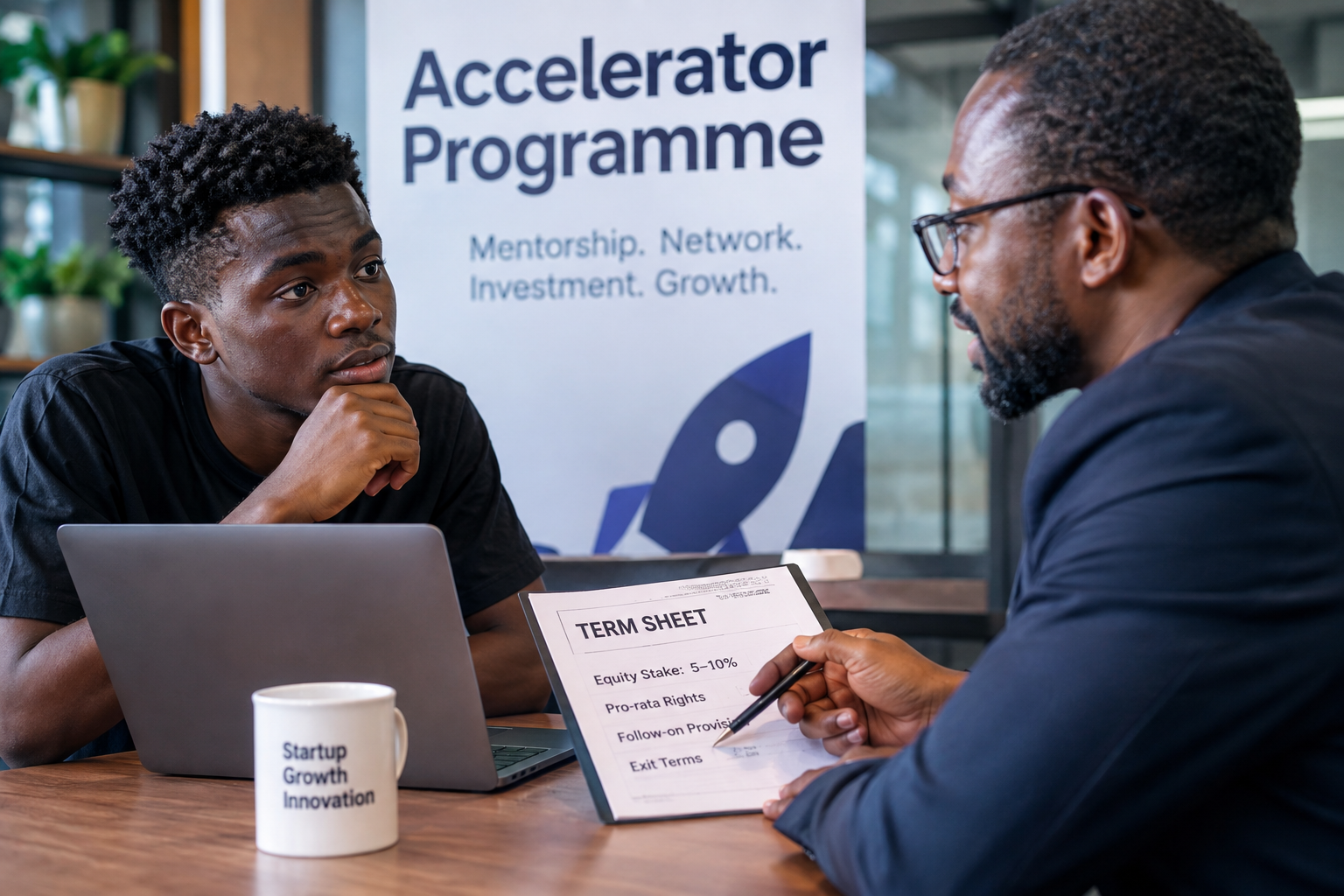
I’ve sat across the table from enough founders at the Lagos Angel Network to know the shape of this conversation. A founder comes in having just been accepted to an accelerator programme — excited, relieved, already mentally spending the cheque. They want to talk about the mentors, the curriculum, the demo day. They do not want to talk about the term sheet. When I ask whether they have read the equity clause carefully, the pro-rata right, the follow-on provision, the answer is usually some version of: “Yes, I signed. It’s standard.”
Standard is doing a lot of work in that sentence.
The accelerator pitch reads like a gift. A few weeks of intensive programming, experienced mentors, a warm introduction to investors, and a cheque — sometimes as small as $20,000, sometimes as large as $150,000 — in exchange for a single-digit equity stake. For a first-time founder in Lagos with no institutional network and no prior capital, it can feel like someone finally opened a door.
That reading is not wrong. But it is incomplete.
The accelerator is also building something for itself — a venture portfolio, a brand, an LP relationship, a DFI co-investment pipeline, and in some cases, an entire second business model funded by the companies it recruits into its programme. The 5% to 10% equity a founder signs away is not simply the price of entry. It is the foundational asset of an institutional capital vehicle that may, by the time it matures, be managing tens of millions of dollars on behalf of development finance institutions, sovereign wealth funds, and family offices who never heard the founder pitch.
Most founders who take accelerator deals sign without seeing that second picture. This piece is about the second picture.
What the Founder Signs
The instrument varies by programme. Some accelerators take equity directly. Others use a SAFE — a Simple Agreement for Future Equity — which converts into equity at the founder’s next priced round, at terms that depend entirely on the valuation that round achieves.
Y Combinator, the world’s most studied accelerator, runs a two-part structure that most African founders who apply to it have not fully unpacked. Per YC’s own published deal terms: YC invests $500,000 through two separate instruments — $125,000 for a fixed 7% ownership of the company on a post-money SAFE, and a further $375,000 on an uncapped SAFE with a Most Favored Nation clause. In a typical scenario where a founder raises their next round at a $15 million post-money valuation cap, the MFN SAFE converts into an additional 2.5% — giving YC total ownership of roughly 9.5% before any subsequent dilution. The stronger the company at its next round, the less expensive the MFN SAFE becomes for YC. The weaker the round, the more dilutive it is for the founder.
For the majority of Nigerian founders engaging with accelerators, the deal looks nothing like YC. Antler — which entered Nigeria in 2025 under the leadership of Anil Atmaramani, appointed as West African partner — invests $100,000 for 10% equity at the inception stage, before traction, before proven metrics, when all a founder has is a vision. That implied valuation of $1 million is low enough that most founders accept it without negotiation, partly because there is no comparable capital at that stage and partly because the equity cost feels abstract at a moment when the cheque feels very real.
The Business the Accelerator Is Actually Building
To understand what an African accelerator is really doing, you need to look at what it becomes — not at what it tells founders it is when they apply.
Ventures Platform is the clearest local illustration, because it has been transparent about its own evolution and has disclosed more of its LP structure than most. Founded in 2016 as a seed-stage fund and accelerator, it ran programmes, backed founders, and built a portfolio. By its own account, it had backed close to 70 of Africa’s most compelling tech companies, with a portfolio that included Paystack at the time of its acquisition. By November 2025, it announced a $64 million first close on its second pan-African fund.
The LP list reads like a development finance institution roll call: IFC, British International Investment, Proparco, Standard Bank, MSMEDA, and AfricaGrow — alongside European family offices and global backers including Michael Seibel. The Nigerian government’s iDICE programme joined as LP, marking the first time the Nigerian government has directly invested in a venture capital fund. Founding Partner Kola Aina described the government’s participation as something the firm hoped to “lean on for regulatory issues, issues that are multi-agency and multi-government.”
The portfolio of founder equity stakes that began as a support programme is now the underlying asset of a $75 million institutional fund. The founders who took early cheques from Ventures Platform’s programme did not sign up for an LP arrangement with BII, IFC, and Proparco. They signed up for a startup programme. The institutional architecture came later — built on top of the portfolio those founders seeded.
The Flat6Labs case makes this architecture more visible, because in August 2025 the organisation formalised what had always existed structurally: it split into two distinct entities, with F6 Ventures launching as an independent venture capital firm led by General Partners Ramez El-Serafy and Dina el-Shenoufy, and Flat6Labs continuing separately as the accelerator programme under newly appointed CEO Yehia Houry. The programme and the fund, once housed under the same brand, are now separate legal structures with separate leaderships.
The IFC’s project disclosure for the Africa Seed Fund makes the architecture explicit. IFC is considering an equity investment of up to $6 million, processed under its Startup Catalyst Program, into Africa Seed Fund Coöperatief U.A. — a Netherlands-based vehicle focusing on pre-seed and seed-stage investments in North, West, and East Africa. The Fund’s General Partner is F6L Africa GP B.V., a private limited liability company incorporated under the laws of the Netherlands, with El-Serafy and el-Shenoufy as its current owners. The same individuals who run the accelerator programme that Lagos and Nairobi founders apply to are the owners of the Dutch GP entity that will receive carry on those founders’ equity stakes when exits occur.
The programme is Flat6Labs. The GP is a Dutch private limited company. The fund vehicle is a Netherlands cooperative. The founder applying from Lagos is engaging with the brand at the front of this chain. The institutional capital sits at the back of it.
The Donor Layer Nobody Mentions
Underneath the equity model sits a second layer that is even less visible from the founder’s chair: the grant and donor capital that funds the programme side of many African accelerators while the equity side builds the investment vehicle.
The IFC’s disclosure confirms that the Africa Seed Fund was launched with the support of GIZ and as part of the Egyptian Agricultural Innovation Project and the Scaling Digital Agricultural Innovations through Startups project. GIZ — Germany’s international development agency — is co-funding the infrastructure of a fund whose financial returns will flow to F6 Ventures’ limited partners. The German government’s development mandate is providing scaffolding for a private asset management business.
This is not improper. The DFI knows the structure; the LP agreement is signed with full disclosure. But the founder presenting at a Flat6Labs programme in Lagos is not presenting to GIZ’s development-impact measurement team. They are presenting to a fund manager that is using concessional public capital to subsidise the cost of discovering their company — and whose upside, if that company breaks out, flows primarily to a Dutch-registered GP vehicle and its institutional LPs.
What the Pro-Rata Right Actually Does — and What Founders Do With It
The equity stake is the headline number. The follow-on provision is the one that compounds, and it is where the gap between the accelerator’s institutional understanding and the founder’s operating understanding is widest.
Per YC’s own published deal terms: “YC also gets a right to continue to invest in subsequent rounds of financing you raise (a ‘pro rata’ right). In many cases we have invested millions of dollars in companies by continuing to support them in later rounds.” This is a precise and honest description of how the accelerator’s economics work over a company’s full lifetime — not just at the founding stake, but at every subsequent round where YC exercises the right.
What I observe at LAN is a version of this dynamic playing out at the angel level, and it reveals something important about how founders engage with pro-rata rights across the board. When we review cap tables of founders who have come through accelerator programmes and are now approaching angel networks for a seed round, a consistent pattern appears: the founder knows their accelerator owns X percent, but they have not modelled what happens to that ownership if the accelerator exercises pro-rata at the seed, and again at Series A. They are thinking about their current round in isolation. The accelerator — and any sophisticated investor with a pro-rata right — is thinking about the full stack.
This observation sharpens rather than complicates the structural argument. The accelerator’s business model is designed around the long arc of a company’s capital journey, from first cheque to eventual exit. The pro-rata right is the mechanism that keeps the accelerator economically attached to that arc at every stage. Founders who read the pro-rata clause as a minor administrative provision are misreading which side of the table they are on. The accelerator signed a pro-rata right because it intends to use it. The instances where it does not use it — where it lets its stake dilute without following on — are typically the cases where the company’s trajectory has made the follow-on economically unattractive. The accelerator’s silence at a subsequent round is itself a signal, and founders who receive it rarely understand what it means.
What the Structure Is Telling You
The Ventures Platform evolution, the Flat6Labs reorganisation, the IFC disclosure, the YC pro-rata clause — these are not isolated data points. They are the same institutional logic expressed in different geographies and at different scales.
An accelerator is not a charity that occasionally earns returns. It is a capital vehicle that uses a programme as its deal-sourcing mechanism. The programme is real. The mentors are real. The network access is real. But structurally, the founder who walks through the programme door is walking into a fund’s pipeline — and the fund’s obligations run not to the founder, but to its limited partners and their return expectations.
Understanding this does not require a founder to distrust accelerators. It requires them to engage with accelerators the way the accelerator is engaging with them: as a counterparty with a capital structure, institutional obligations, and a portfolio thesis that exists independent of whether any individual company in the cohort makes it. The accelerator is not betting on your company. It is betting on a portfolio, and your company is one position in it.
The programme is the product that founders see. The portfolio is the product the accelerator is building. Both are real. Only one of them is being explained.
