


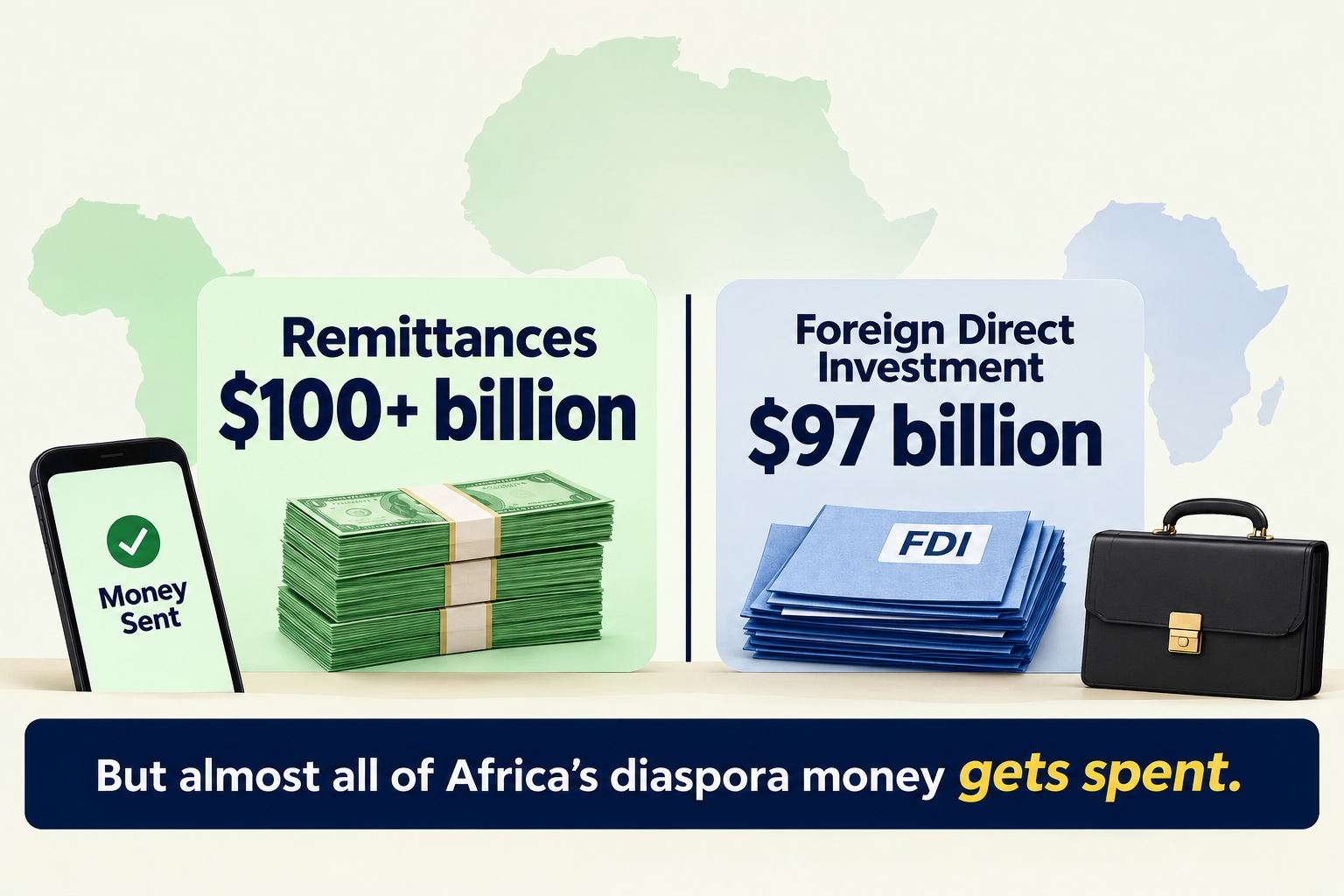
Not close, either. Over $100 billion in remittances against roughly $97 billion in FDI. Nobody throws a summit for that. There’s no ribbon-cutting, no press release, no minister standing next to a giant novelty cheque. It just happens, in a few hundred million individual transfers, every single month, quietly outperforming every foreign investor pitch deck on the continent combined.
And then almost all of it gets spent by Thursday.
The Money Is Real. The Infrastructure Around It Isn’t.
School fees. Rent. A hospital bill nobody saw coming. A little extra for December. That’s what remittances are for, and there’s nothing wrong with that — this money is doing exactly what it was sent to do.
But here’s the structural gap nobody’s pricing correctly: almost none of that $100 billion touches a savings account, a bond, an equity stake, or a business loan. It arrives, it gets spent, and it’s gone. Multiply that by every recipient, every month, every year, and you’re watching the largest pool of private African-connected capital on earth flow straight through the economy without ever being invested in it.
We’ve Tried To Fix This Before. It Mostly Hasn’t Worked.
Ethiopia tried a diaspora bond in 2008 to build a dam. It raised something like $4 million against a target that assumed hundreds of millions. Kenya’s 2011 diaspora bond pulled in about a quarter of what it was aiming for. Kenya tried again with M-Akiba, the world’s first mobile-phone-based government bond — genuinely clever idea — and subscriptions still came in soft.
The pattern isn’t that diaspora Africans don’t want to invest at home. It’s that nobody built the rails to make it easy, trustworthy, and liquid enough to compete with just sending the money and being done with it.
I once had a friend in the UK who owed me money for a purchase — simple enough. But the pound was having a bad week against the local currency, and rather than send it at a loss, he held off, hoping the rate would recover. I felt that delay on my end too, even though it had nothing to do with me. In the end he couldn’t wait any longer than I could, and he sent it anyway, at a worse rate than either of us wanted. Nothing about that transaction should have depended on currency timing. It did anyway, because there was no way to separate the two.
Ghana Is The Exception Worth Studying
Here’s a number that should get more attention than it does: Ghana’s remittance inflows hit nearly $7.8 billion in 2025, up from about $4.6 billion in 2024. Bank of Ghana Governor Dr. Johnson Asiama disclosed the figures himself at a “Central Bank Bridge: Remit2Invest” roundtable in the US this April, as reported by Citinewsroom: “In 2024, before I came on, Ghana recorded approximately $4.6 billion in remittances. This flow continues to rise through last year, 2025. We recorded nearly $7.8 billion by the end of last year.” Finance Minister Dr. Cassiel Ato Forson repeated the same figure independently at the Ghana-UK Investment Summit in London weeks later, and Bank of Ghana’s own quarterly data — its Summary of Economic and Financial Data — shows the build-up landing exactly there by Q4.
That’s not a fluke. It followed a specific regulatory move: Notice No. BG/GOV/SEC/2025/25, the Bank of Ghana’s Updated Guidelines for Inward Remittance Services by Payment Service Providers (UGIR 2025), issued in August 2025, which replaced the prior 2023 framework and forced payment service providers and fintechs to route transfers through formal, trackable cash-to-account channels rather than informal side arrangements. Governor Asiama was explicit that closing those informal loopholes — where some operators paid out in cedi locally while keeping the foreign currency abroad — was what pulled the dollars back into Ghana’s own banking system. Regulation, done deliberately, moved billions from informal and untracked to formal and countable in about eighteen months.
That’s the actual playbook. Not a bigger marketing campaign asking the diaspora to feel more patriotic. Infrastructure and regulatory plumbing that makes formal, investable channels the easy choice instead of the annoying one.
The Fintechs Already Built Half The Pipe
This is where it gets interesting, because the hard part — moving money cheaply and fast — is basically solved already.
LemFi says it now processes over a billion dollars a month — a figure the company disclosed itself alongside its $53 million Series B round in January 2025, not an independently audited number, but a scale claim nobody in the space has seriously disputed. NALA has moved a billion-plus across Africa and Asia and is now building B2B payment infrastructure on top of its consumer app. Transfer costs that used to sit at 7-12% have been pushed down toward 1-3% by competition between platforms like these.
They built the pipe. Almost nobody has built what sits on the other end of it — the savings product, the diaspora bond marketplace, the equity platform — that would let that same dollar, once it lands, choose to stay invested instead of getting spent immediately.
Temi Popoola, who runs the Nigerian Exchange Group, said the quiet part out loud at a recent Africa Capital Forum panel: imagine a Nigerian abroad sending money through any fintech app, and that transfer having “a termination on the capital markets” instead of just landing in a bank account. That’s not a hypothetical anymore. That’s a plumbing problem, and plumbing problems get solved by whoever builds the right pipe first.
Why This Is A Real Business, Not A Development Slogan
I want to be careful here, because “unlock diaspora capital for development” is the kind of phrase that shows up in a hundred conference panels and produces almost nothing. What makes this different from that panel-circuit version of the idea is that it doesn’t require anyone to be generous.
A diaspora saver who’d rather earn a return in naira-denominated bonds than watch a foreign currency account do nothing isn’t donating. A platform that lets someone in London put $500 a month into a Kenyan money-market fund instead of a UK savings account earning less isn’t running a charity. These are ordinary financial products serving an audience whose only real problem right now is that almost nobody has built a good one for them yet.
The Honest Caveat
The failure rate on formal diaspora finance products has been genuinely high, and it’s worth saying plainly: trust is the actual product being sold here, more than the yield. Ethiopia and Kenya’s early bonds didn’t fail because the diaspora had no money. They failed because building institutional trust across a currency, a government, and a distance takes longer and costs more than most of these programs budgeted for.
Anyone building here needs to treat that trust-building cost as real capital expenditure, not a marketing afterthought.
What I Think This Actually Is
Strip away the “diaspora engagement” language every government uses, and what’s left is a market with defined size, proven demand for the transfer rail, and almost no competition on the investment layer sitting behind it. A hundred billion dollars a year, arriving reliably, currently captured almost entirely by consumption.
The founders who build the trustworthy, liquid, well-regulated bridge between “money my family sent” and “money I chose to invest” aren’t chasing a niche. They’re building the on-ramp to what might be the single largest untapped capital pool connected to this continent.
That’s the bet worth watching next.
