

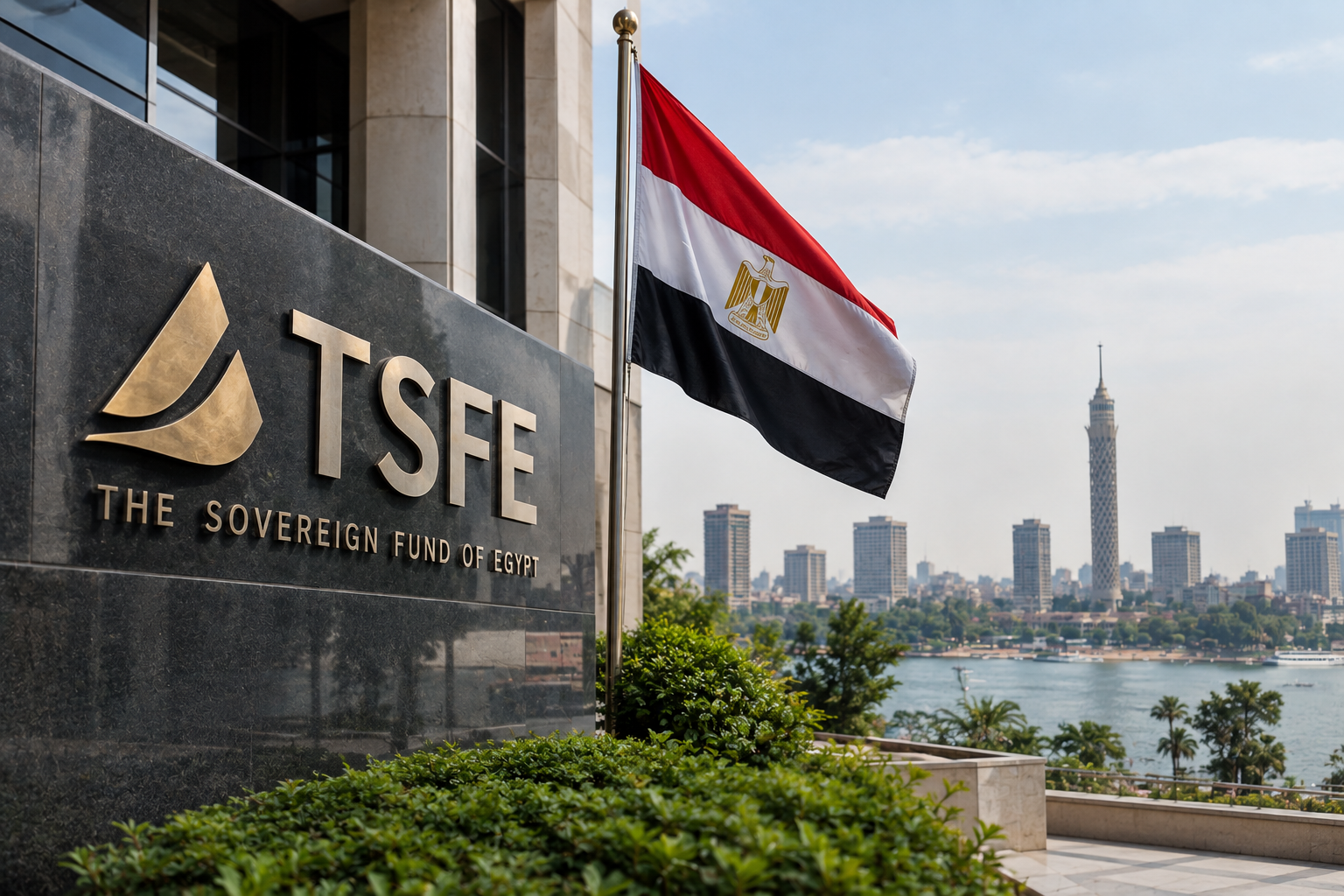
The Sovereign Fund of Egypt was created in 2018 with a narrow, domestic job: take Egypt’s underused state assets — eventually an estimated 3,000 units, and later a first-phase list of 370 state-owned enterprises announced in February 2025 — and turn them into investable, revenue-generating platforms through partnerships with outside capital.
As of August 2026, that mandate is expanding outward: Egypt’s Minister of Investment and Foreign Trade, Mohamed Farid, announced TSFE is preparing its first Africa-focused investment vehicle, targeting banking, non-banking financial services, tourism, health, and education, with Kenya, Nigeria, and Côte d’Ivoire named as the markets under evaluation. No size, launch date, or funding structure has been disclosed for this vehicle in any source reviewed for this piece — the reporting itself is explicit that these details remain unannounced.
What The Headline Number Is Actually Made Of
TSFE’s own account of its finances is worth reading carefully before taking its scale at face value. In a March 2023 interview with Global SWF, the fund’s own leadership described its assets under management at the time as EGP 60 billion — roughly $2 billion — and explained its financing model directly: cash from the Treasury, transfers of state-owned assets from government, and third-party capital it manages but doesn’t own. By the end of 2024, that figure was being reported at roughly $12 billion — a sixfold increase in under two years.
Nothing in the sources reviewed for this piece breaks down how much of that growth reflects fresh capital or investment returns versus the book value of state enterprises simply being transferred onto TSFE’s balance sheet. Given the fund’s own description of asset transfers as one of its three core funding mechanisms, and given that a further 370-enterprise transfer was announced in February 2025, a meaningful share of any current AUM figure likely represents assets moved onto the books rather than capital actually raised or deployed. That distinction matters for a fund now proposing to deploy capital abroad: book-value asset transfers are not the same thing as investable cash.
It’s also worth noting that the $12 billion figure being cited in press coverage as recently as June 2026 traces back to end-2024 — no more current figure could be located, meaning the headline number driving coverage of TSFE’s African ambitions may be a year and a half old.
An Independent Governance Score That Hasn’t Moved
Global SWF, which independently scores the world’s 200 largest sovereign wealth funds and public pension funds on governance, sustainability, and resilience using 25 publicly-verifiable criteria, rates TSFE at 40% overall for 2026 — 5 out of 10 on governance, 4 out of 10 on sustainability, 1 out of 5 on resilience — unchanged from its 2025 score. For context, Global SWF’s own 2024 scoreboard put the global average governance sub-score across all 200 funds at 77% — roughly one and a half times TSFE’s own 50% governance sub-score — and the same scoreboard credited Saudi Arabia’s PIF at 96% overall and Abu Dhabi’s Mubadala at 92% overall, both far above TSFE’s 40% blended score.
TSFE is not a small or obscure fund by regional standards, and it is not new — it’s seven years old. A flat governance score across two consecutive annual assessments, sitting well below both the global average and its immediate Gulf peers, is a specific, checkable fact about institutional maturity, not a vague characterization.
The Wider Context: Egypt Still Needs the Gulf’s Money
TSFE’s outward ambitions are unfolding while Egypt’s own fiscal position still depends heavily on external support. Global SWF has reported that Gulf sovereign funds — Saudi Arabia’s PIF, alongside Qatari and Emirati counterparts — have pledged a combined $25 billion to help offset slowing public investment, against a backdrop of IMF fiscal conditions tied to a $3 billion loan and a heavy external debt load.
That is the immediate financial environment TSFE itself operates in: a fund whose own government still needs tens of billions in external sovereign support to stabilize its books is now the vehicle proposing to become an outbound investor across three other African economies. Neither fact makes the other false, but treating TSFE’s African expansion as evidence of institutional strength, without holding it against Egypt’s own continued reliance on Gulf capital, would be an incomplete picture of where the fund is actually starting from.
What Else Is Moving Domestically
TSFE’s most concrete recent transaction is domestic, not African: in March 2026, the Ministry of Investment invited investment banks to bid on leading a public offering of up to 20% of Misr Life Insurance Company, a TSFE-affiliated insurer, with EFG Hermes subsequently mandated to run the process. Reporting from June 2026 put the expected proceeds at roughly EGP 14 billion (about $269 million), targeting completion by the end of July 2026. No confirmation that this listing actually closed by that date could be found in the sources reviewed for this piece — as of this writing, that should be treated as a pending transaction, not a completed one, and checked directly against EGX listing records before being cited as finished.
The Actual Question
None of this means TSFE’s African plans are unfounded — sovereign funds routinely internationalize well before every domestic governance metric is perfect, and Gulf funds have done exactly this while running far higher GSR scores. But TSFE’s specific combination — a flat, well-below-average governance score across two straight years, a headline AUM figure that hasn’t been updated in published reporting for a year and a half and likely overstates liquid investable capital, a marquee domestic IPO whose completion is unconfirmed, and a home government still leaning on $25 billion in Gulf sovereign support — is a specific enough profile that it deserves to be named directly rather than glossed over in coverage of the Africa announcement.
The question worth asking directly of TSFE or the Ministry of Investment, before this story runs further: what changed operationally, not just rhetorically, that makes 2026 the right moment to deploy Egyptian sovereign capital into Kenyan, Nigerian, and Ivorian markets, rather than finishing the harder work of professionalizing the fund’s own domestic asset base first.
