

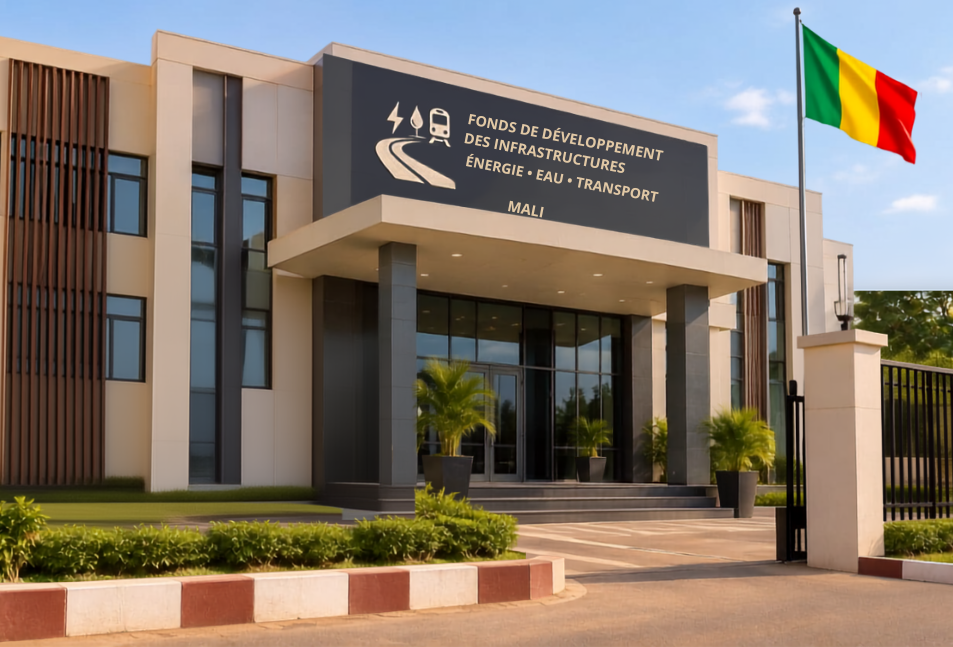
Mali’s Energy, Water and Transport Infrastructure Development Fund was created in 2023 under an overhauled mining code, financed exclusively by contributions from large- and small-scale mining permit holders: 1% of quarterly turnover plus 10% of ad valorem tax in a mine’s first five years, rising to 2% of turnover thereafter.
Speaking on state television in early August 2026, Finance Minister Alousseni Sanou said the fund had mobilized 109.14 billion CFA francs between 1 January 2025 and 30 June 2026, generating at least 50 billion CFA francs a year — a base the government believes it can leverage into up to 500 billion CFA francs, or roughly $883.1 million at the prevailing exchange rate, for energy, water, and transport projects. Infrastructure Minister Dembele Madina Sissoko said proposals already presented to the fund span railway development, road construction, river vessels for the Niger River corridor, and projects tied to state-owned Mali Airlines.
One detail in the Reuters account of Sanou’s remarks is easy to miss and worth naming directly: the government described this as the first meeting of the fund’s governing body since its creation — meaning contributions had already been flowing in for roughly a year and a half before the institution responsible for allocating them formally convened. That gap between revenue collection and institutional oversight starting is itself worth watching, independent of anything else in this piece.
What the Leverage Number Actually Means
The $883.1 million figure is not money the fund holds today. It is a projected ceiling on how much could theoretically be raised by using the fund’s annual mining-contribution stream — at least 50 billion CFA francs a year — as collateral or credit enhancement to borrow against, rather than spending contributions directly as grants.
That distinction matters: reaching 500 billion CFA francs in actual infrastructure financing depends on Mali successfully engaging international capital markets or development finance institutions on terms that reflect the country’s current political risk profile, not simply on continuing to collect mining royalties. The 109.14 billion CFA francs mobilized so far is real, collected revenue. The 500 billion CFA franc figure is an aspiration contingent on financing Mali has not yet secured.
A Separate, Larger Number: What the December 2025 Audit Found
Alongside the fund’s own contribution stream, Mali’s finance minister said in early December 2025 that a government audit had recovered 761 billion CFA francs (about $1.2 billion) in arrears from mining companies — correcting an earlier version of this piece, which cited December 2024; the announcement came roughly a week after the Barrick settlement, not more than a year before it, which matters for reading the two figures against each other. Alousseni Sanou made the announcement at a ceremony presenting the audit report to President Assimi Goita, and named seven other operators — B2Gold, Allied Gold, Resolute Mining, Endeavour Mining, Ganfeng, and Kodal among them — who had separately settled their own arrears and migrated to the new mining code earlier, which is real evidence the 761 billion figure aggregates many companies’ payments rather than describing Barrick’s alone.
What it does not do is resolve the overlap question directly. Multiple outlets reported that Sanou, asked directly, did not say whether the recovered sum included Barrick’s settlement. That is a materially different fact than a reporting gap: Mali’s own finance minister had the opportunity to reconcile the two figures in the same public appearance where he announced one of them, and did not. Barrick has not addressed the question publicly either. Until one side does, the responsible reading is that the two figures are more likely separate than overlapping — given the other named companies’ contributions and the roughly $1.2 billion total’s scale relative to Barrick’s $430 million — but not confirmed as such by anyone with the underlying ledger.
The Test Case: What Actually Happened With Barrick
The clearest evidence of how Mali’s 2023 mining code actually functions in a contested case comes from its two-year standoff with Barrick Mining over the Loulo-Gounkoto gold complex — one of West Africa’s largest gold-producing assets. The dispute originated in the same 2023 code that created the infrastructure fund, which raised the state’s potential equity stake in mining projects to as much as 35%, up from 20% under the prior 2019 code.
Mali’s government arrested four senior Barrick employees in 2024 on financial crimes allegations, issued an arrest warrant for former CEO Mark Bristow, and in 2025 seized roughly 3 metric tons of Barrick’s gold and placed the mine complex under state administration, forcing a full suspension of operations. Barrick filed international arbitration at the ICSID and wrote off roughly $1 billion in revenue from the Malian operation during the standoff.
The dispute ended in a settlement announced 24 November 2025: all criminal charges against Barrick and its employees were dropped, the detained staff were released, state administration of the mine ended, and Barrick agreed to pay approximately $430 million (244 billion CFA francs) while withdrawing its ICSID claims. In exchange, Mali extended Barrick’s mining permit by ten years and Barrick agreed to sign the 2023 mining code it had been contesting. Operations resumed in stages, with full operational control restored by February 2026.
Read against the infrastructure fund, this settlement is the strongest available evidence that Mali’s fiscal strategy can extract large, real payments from major operators — $430 million from a single company is more than double the fund’s entire 18-month mobilization total. It is also the clearest evidence of the cost of that strategy: it required detaining employees, seizing physical gold stocks, and forcing a year-long production suspension at one of the region’s most significant mines before a resolution was reached. Whether that outcome represents a repeatable model or a uniquely high-stakes one-off is not something either side has stated publicly, and shouldn’t be assumed either way.
Governance Verification Is Mid-Review, Not Settled
Mali’s extractive-sector transparency has an actual scorecard, not just general concern. The Extractive Industries Transparency Initiative gave Mali a score of 65.5 points in its most recent full Validation (2022), describing it as “fairly low” and citing weak civil society engagement and mining-licence allocation transparency as priority concerns, particularly given the risk of licences passing into contested or conflict-affected hands.
A targeted follow-up assessment in 2024 found meaningful progress on some requirements, with corrective actions still outstanding and Mali’s next full Validation scheduled to begin 1 July 2026 — meaning an updated, independent assessment of Mali’s mining-sector governance is underway at essentially the same time this infrastructure fund is being publicly promoted. That timing invites an assumption this piece should not make without checking it: that the 2026 Validation will examine the fund’s disbursement mechanics specifically. It probably will not, at least not by name.
The EITI Board’s own 2024 decision setting the terms for this Validation lists the specific corrective actions Mali must demonstrate progress on: civil society engagement, contract and licence allocation, licence registers, and contracts, plus outstanding items from the 2022 Validation. The infrastructure fund is not named among them, and EITI Mali has not issued any public statement, that this piece could locate, addressing whether the fund’s disbursement mechanics fall within this Validation’s scope. That does not rule it out — Validations can and do examine revenue flows adjacent to their named corrective actions — but it means the assumption should run the other way: absent a specific EITI statement extending the review to this fund, treat the two as running on parallel but separate tracks.
What This Means, Taken Together
Mali has built a mining-revenue mechanism that is demonstrably collecting real money — 109.14 billion CFA francs in eighteen months — and has just tested its leverage, in the most literal sense, against one of the largest operators in its gold sector, extracting a $430 million settlement after a standoff serious enough to include detained executives and seized gold.
That is a genuinely unusual amount of evidence for a two-year-old fiscal mechanism to have generated about its own enforceability. What remains open is whether the fund’s governance can be verified independently — EITI’s review is mid-cycle, not concluded — and whether Mali can convert its collected 109.14 billion CFA francs into the 500 billion CFA franc leverage target without either further operator confrontations or financing terms that reflect a meaningfully elevated political risk premium.
Both questions have concrete, checkable answers coming within the next year: EITI’s next Validation, and whatever external financing arrangement, if any, Mali actually signs to reach for the $883 million ceiling.
