

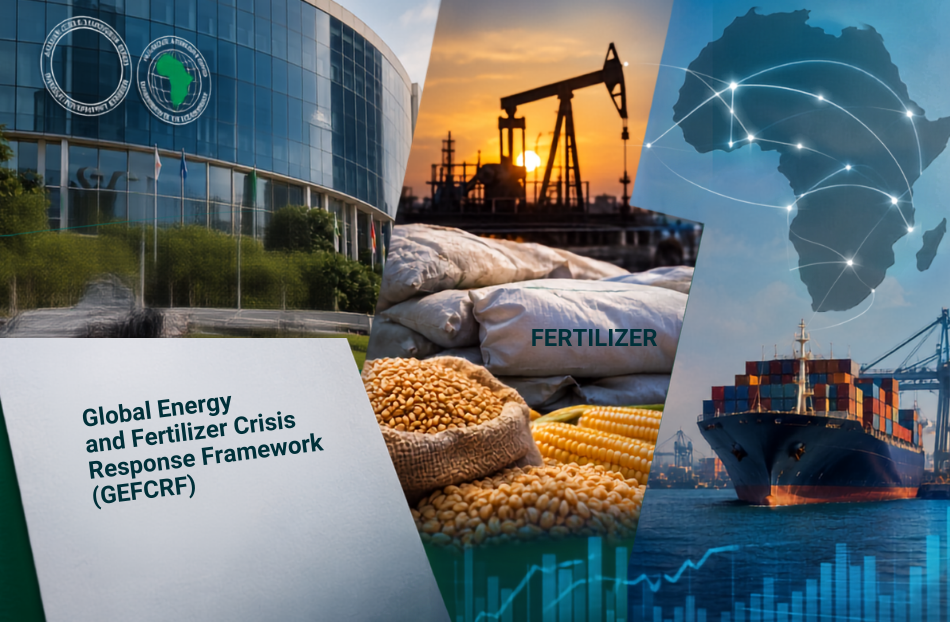
On 1 September, the African Development Bank’s Board approved the Global Energy and Fertilizer Crisis Response Framework — GEFCRF, because AfDB has never met a crisis it couldn’t turn into an acronym. Up to $5.1 billion, split between $4.1 billion in additional Bank lending and up to $960 million from the African Development Fund, its concessional arm. The stated trigger: spillover from the Middle East conflict into energy prices, fertilizer costs, food supply chains, and the shipping routes that move all three across the continent.
That raises AfDB’s total 2026 lending target to roughly $12.7 billion. It’s a real, dated, board-approved number — confirmed across AfDB’s own press materials and independently reported by outlets from Businessday to World Fertilizer within days of the Board vote. What’s more interesting than the number is what it’s the third of.
Four Pillars, One Year, Under Review
GEFCRF is built to do two things at once — cushion the immediate shock to food, fuel and fertilizer supply while trying to leave countries less exposed to the next one — with the finer print left to policy documents rather than a press release. It’s demand-driven, tailored to each country’s exposure, and set to expire after one year unless AfDB’s Board reviews and extends it.
That structure — broad mandate, short leash, built-in review clause — isn’t new. It’s the same shape AfDB used for its COVID-19 Response Facility, and again for the $1.5 billion African Emergency Food Production Facility it launched in 2022, after Russia’s invasion of Ukraine disrupted supply chains. AfDB’s own description of that facility puts a number on the shock it was responding to: a shortfall of at least 30 million metric tons of food — wheat, maize and soybean imports the continent depended on — which the Bank cited directly as the reason AEFPF existed. GEFCRF is explicitly built on that precedent. AfDB says so in its own announcement.
Martin Fregene, the Bank’s Officer in Charge Vice President for Agriculture, Human and Social Development, tied the new facility to the same logic on the record:
“The Bank’s new Global Energy and Fertilizer Crisis Response Framework gives us a way to respond to the pressures African farmers are facing as the conflict in the Middle East disrupts global trade. When fertilizer becomes too expensive or difficult to find, farmers use less and harvests can suffer. Access to finance is part of the solution, helping businesses keep fertilizer moving to farmers, while we work to build stronger fertilizer markets and more local supply in Africa.”
Abdul Kamara, AfDB’s Acting Vice President for Country and Regional Operations, framed the ambition beyond the cheque itself: “A crisis response must do more than cushion the shock. It must make countries stronger. That is exactly what this framework aims to achieve.” Both quotes are drawn directly from AfDB’s own press release, not paraphrased from secondary coverage.
The Timing Nobody Flagged
Here’s the detail worth sitting with. In August, three weeks before GEFCRF’s Board approval, AfDB hosted a “lessons learnt” forum on the AEFPF at the African Food Systems Forum in Kigali — ministers, development partners, researchers, gathered specifically to examine what worked and what didn’t in the last emergency food facility. The ink on that retrospective was barely dry before the Bank stood up its next one.
That’s not necessarily a criticism. Emergency facilities are, by design, meant to be temporary and reviewed rather than permanent. But three crisis-response vehicles in four years — COVID, then Russia-Ukraine’s food shock, now Middle East spillover into energy and fertilizer — is a pattern worth naming plainly: AfDB has effectively built a standing emergency-response muscle it now exercises roughly once every eighteen months, each time citing a different geopolitical trigger and each time asking its own Board for fresh headroom to do it again.
A Second DFI Is Running The Same Play
GEFCRF isn’t the only nine-figure-plus African DFI response to Middle East spillover this year. Afreximbank’s own Board approved a $10 billion Gulf Crisis Response Programme on 31 March 2026 — liquidity support, trade and payment stabilisation, targeted financing for energy, tourism, aviation, fertiliser and food imports under acute stress, citing the same underlying shock. Dr. George Elombi, Afreximbank’s President and Chairman, framed it as institutional muscle memory rather than a new posture: “This crisis response programme is in tune with our DNA. We understand how our economies work and the pain points associated with these transitory crises.”
Two of the continent’s largest development finance institutions, mobilising a combined $15 billion-plus, within roughly six months of each other, against the same geopolitical trigger. That could be genuine complementary specialisation — Afreximbank working the trade-finance and payments side, AfDB working macro-fiscal stabilisation and physical supply chains. It could also be two large institutions independently building parallel emergency capacity against one shock, with no public evidence of the two coordinating scope or sequencing. Nothing in either announcement says which. That’s worth someone at both institutions being asked directly, because the answer changes whether this is efficient continental crisis response or duplicated mobilisation.
The Concessional Window Is Doing Double Duty
The $960 million coming from the African Development Fund deserves its own scrutiny, because it isn’t new money in the way the headline figure implies. ADF closed its 17th replenishment in London on 18 December 2025 — a record $11 billion from 43 partners, per AfDB’s own press release announcing the outcome, a 23% increase over the previous replenishment and the Fund’s largest resource mobilisation in its 53-year history. That money was raised to fund concessional lending to Africa’s poorest and most fragile states over a multi-year cycle. Less than nine months later, up to $960 million of that same freshly-replenished pool is being redirected into a one-year emergency facility.
That’s not evidence of mismanagement — concessional windows are supposed to flex toward acute need. But it is a real trade-off, not free capacity: every dollar GEFCRF draws from ADF-17 is a dollar not available for the longer-cycle development lending that replenishment round was negotiated to fund. Nobody in AfDB’s own materials frames it that way. Worth doing the arithmetic yourself before taking the $12.7 billion headline figure as pure addition rather than partial reallocation.
What The Named Voices Don’t Say
Kamara and Fregene’s quotes confirm the framework’s intent — protect households, keep supply chains moving, build resilience beyond the immediate shock. Neither addresses the two questions this piece has actually raised: whether GEFCRF’s design accounts for Afreximbank’s parallel $10 billion facility targeting the same trigger, or whether AfDB’s own board weighed the ADF-17 trade-off explicitly before approving the reallocation. Both gaps are answerable, in principle, by AfDB’s own board minutes or a direct question to either institution — they just aren’t answered in anything public yet.
The more useful test is time, not rhetoric. AEFPF’s own multi-year appraisal cycle suggests real disbursement data on GEFCRF won’t surface for a while. Until it does, the reportable conclusion is narrower than “AfDB is responding to a crisis”: it’s that AfDB has now built and rebuilt the same emergency-response machinery three times in four years, is running it in parallel with a similarly-sized Afreximbank facility nobody has confirmed is coordinated, and is funding part of it by pulling forward capital a record replenishment closed less than nine months ago to protect for exactly the opposite purpose.
