


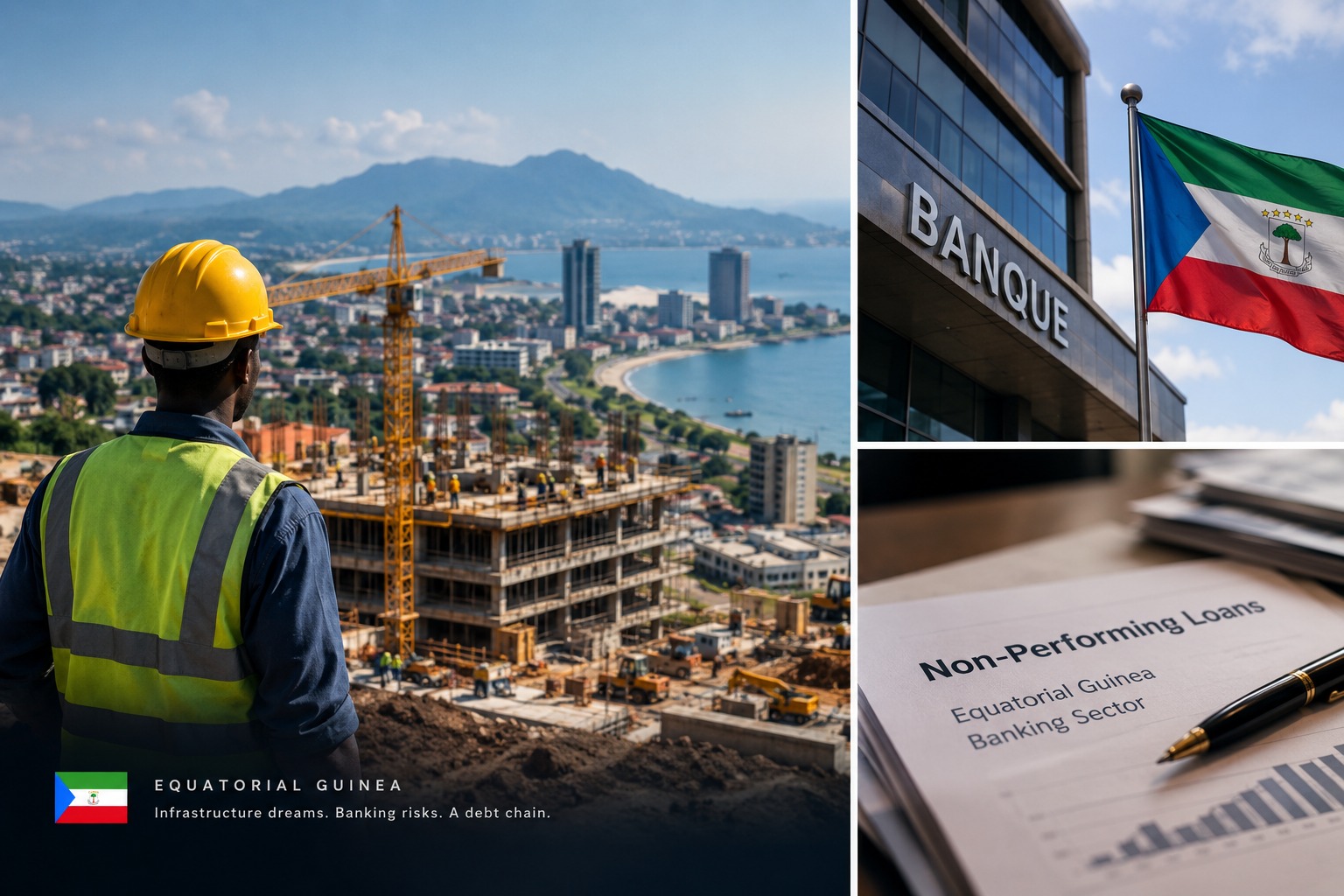
Equatorial Guinea built its infrastructure boom on an assumption that looked safe while oil money was flowing: the state would commission the roads, public buildings and other projects; contractors would borrow to build them; and government payments would eventually close the loop. When the oil cycle turned and public payments slowed, that loop broke. The contractors were left owing banks, and the banks were left holding loans whose repayment depended on a government that had not paid its own bills.
That is the part of Equatorial Guinea’s debt story that matters to capital. The problem was not confined to the government’s accounts. A sovereign arrear migrated into corporate balance sheets, then into bank loan books, and eventually into securities and provisions. What began as a public-works financing model became a mechanism for transmitting sovereign payment risk into the banking system.
A Construction Boom That Outlived The Cash
During the oil boom in the mid-1990s through the 2000s, Equatorial Guinea directed large public revenues into major infrastructure projects. Construction companies borrowed from domestic banks to execute government contracts. The IMF says many of those companies became unable to service their loans once the government began accumulating arrears. By 2019, non-performing loans were rising sharply, with most of the stressed exposures originating in heavy lending to construction companies holding government contracts. (IMF 2019, IMF 2024).
The scale was large enough to become a banking-system problem. An IMF audit of the government’s construction arrears found CFAF1.3825 trillion in claims from 470 companies in June 2019, equivalent to 20.8% of GDP at the time. But the audit also exposed a second problem: only 80 of the 470 claimants had the contracts and procurement documentation required for their claims to be validated. The rest were treated as non-validated claims, although the government subsequently recognised some of them for payment. (IMF 2024).
This distinction matters because the headline number was never simply a pile of clean, undisputed invoices. It was a stock of claims that had to be audited, discounted, classified and, in some cases, converted into different forms of payment.
The Debt Changed Shape
By August 2023, the recognised stock had fallen to CFAF584.1 billion after audits, taxes and other adjustments. Of that amount, CFAF431.8 billion was audited debt to be paid in cash, CFAF47.5 billion had been securitised, and CFAF104.8 billion represented non-audited claims that the government was nevertheless paying where public works had been completed. From 2019 through 2023, the government had made cumulative payments of CFAF572.2 billion, including CFAF206.1 billion through securitisation. (IMF 2024)
The movement is important. Securitisation did not make the government’s obligation disappear. It changed the instrument through which the obligation sat in the financial system. In effect, a contractor’s claim on the state could become a security that a bank could hold, finance against or use to replace a distressed loan exposure.
That mechanism was already visible in 2019. The IMF reported that the government securitised arrears owed to a large construction company whose overdue bank loans were weighing on a systemic bank. The bank used the securities as collateral to borrow from its parent company, reducing its reliance on central-bank liquidity. The operation therefore created liquidity around a sovereign claim, but it did not erase the underlying risk. (IMF 2019).
COBAC says this exposed the banking system to both concentration risk in construction and counterparty risk to the state, damaging banks’ loan portfolios, liquidity, solvency and profitability. (Financial Stability in Central Africa 2019 report)
When A Government Arrear Becomes A Bank Capital Problem
The consequences showed up in the banking system. The IMF reported an NPL ratio of 53% at end-2020, driven mainly by government non-payment on construction-related contracts funded by banks. The U.S. State Department similarly described the sector as weighed down by non-performing loans, undercapitalisation and low liquidity, linking the problem to government arrears with construction firms. (IMF 2021).
The exposure was not evenly distributed. U.S. reporting has identified significant concentrations of NPLs at individual banks, while earlier IMF reporting described stress at a systemic bank and noted its dependence on BEAC funding. The government subsequently acquired Afriland First Group’s shares in CCEI in 2021, after years in which the bank had financed infrastructure projects linked to government contracts. (IMF 2019).
That sequence is revealing. The banking system was not simply lending into an ordinary construction cycle. It was lending against projects whose ultimate payer was the state. When the state delayed payment, the contractors’ creditworthiness deteriorated; when the contractors stopped paying, the banks had to recognise the deterioration; and when bank capital and liquidity came under pressure, the public sector had an incentive to intervene.
The risk therefore travelled in a circle: government arrears weakened contractors, contractor defaults weakened banks, and weak banks increased the pressure on government to resolve the arrears.
The Clean-Up Is Now A Banking-Sector Policy
Equatorial Guinea’s current arrears strategy makes that linkage explicit. In its 2025 assessment, the IMF said the government’s new clearance strategy prioritised arrears associated with non-performing loans at private banks over four years, with the stated objective of restoring the capital position of troubled banks. (IMF 2025).
The mechanics matter. If a government payment allows a bank to resolve an NPL and reduce the provision attached to it, the payment is doing more than settling a supplier invoice. It is also releasing capital from a bank balance sheet. That can improve solvency and, in principle, create room for lending again.
The IMF’s third review, published in 2026, said authorities had begun making payments under the arrears strategy to strengthen undercapitalised privately owned banks. But the plan had not yet received approval from COBAC, the regional banking supervisor. The IMF said that approval would allow banks to remove provisions for NPLs related to construction-company arrears. (IMF 2026. That delay is not a technical footnote. It illustrates who ultimately decides how a sovereign arrear is recognised inside the banking system. The government can promise payment, but the treatment of the resulting asset on a bank’s balance sheet remains subject to regional prudential rules.
The Real Question Is Who Financed The Waiting
The government’s problem has therefore become a problem of risk allocation. Contractors financed public works before receiving the state’s money. Banks financed those contractors. The banks then carried the cost of delayed sovereign payment through bad loans, provisions and weaker capital. Where securitisation was used, the claim was converted into an instrument that could support liquidity without eliminating the state’s obligation.
That is why the size of the remaining arrears is only one measure of the problem. The more consequential question for investors is what those arrears have already cost the financial system in forgone lending, provisions, capital and liquidity—and how much of that cost is eventually transferred back to the sovereign.
The World Bank’s more recent assessment suggests the clean-up has not yet fully restored credit transmission: non-performing loans were still around 32% of total loans in Equatorial Guinea, adversely affecting banking stability and private-sector credit. (World Bank, 2025) The number is far below the 53% recorded at end-2020, but it is still high enough to show that the banking problem did not end when the headline arrears stock fell.
There is another risk beneath the repayment schedule. Equatorial Guinea’s hydrocarbon revenues, the fiscal cushion that supported the earlier infrastructure model are under pressure from declining production. The IMF expects the authorities to keep public debt below a 50% of GDP anchor while undertaking fiscal adjustment. That makes arrears clearance a competition for scarce fiscal space rather than a simple exercise in paying old bills. (IMF 2025, IMF 2026)
The state is therefore trying to do two things at once: clean up obligations created during the infrastructure boom and rebuild a banking system damaged by those same obligations. The success of one depends partly on the other.
Equatorial Guinea’s real task isn’t just paying what it owes, it’s making sure that payment actually fixes something. If clearing arrears puts real capital back into the banks and gets credit flowing to businesses again, this becomes genuine financial-sector repair. If it doesn’t, the country just swaps one form of bad debt for another and calls it settled. The success of one depends partly on the other. The interesting part is figuring out who actually carried the risk during the years the state wasn’t paying, and whether the final deal makes those institutions whole rather than quietly shifting the burden back onto the public.
