

The World Bank has not approved a new lending project for Equatorial Guinea since 1992. Its historical project record runs through education, agriculture, health and petroleum-sector technical assistance before going quiet. Then came the oil boom. Equatorial Guinea became one of Africa’s wealthiest countries on a GDP-per-capita basis, spent heavily on infrastructure and built much of its modern economy around hydrocarbons. The World Bank’s lending relationship, however, never returned to anything resembling its earlier form.
That makes the Bank’s intervention in July 2025 worth reading carefully.
There was no loan announcement. No financing package. No new infrastructure project.
Instead, the Bank published the 2025 Equatorial Guinea Economic Update, an economic diagnosis built around a question that is becoming increasingly difficult for the country to avoid: what replaces oil when the resource that created the economy begins to disappear?
The answer offered by the report is not another mineral deposit or industrial megaproject.
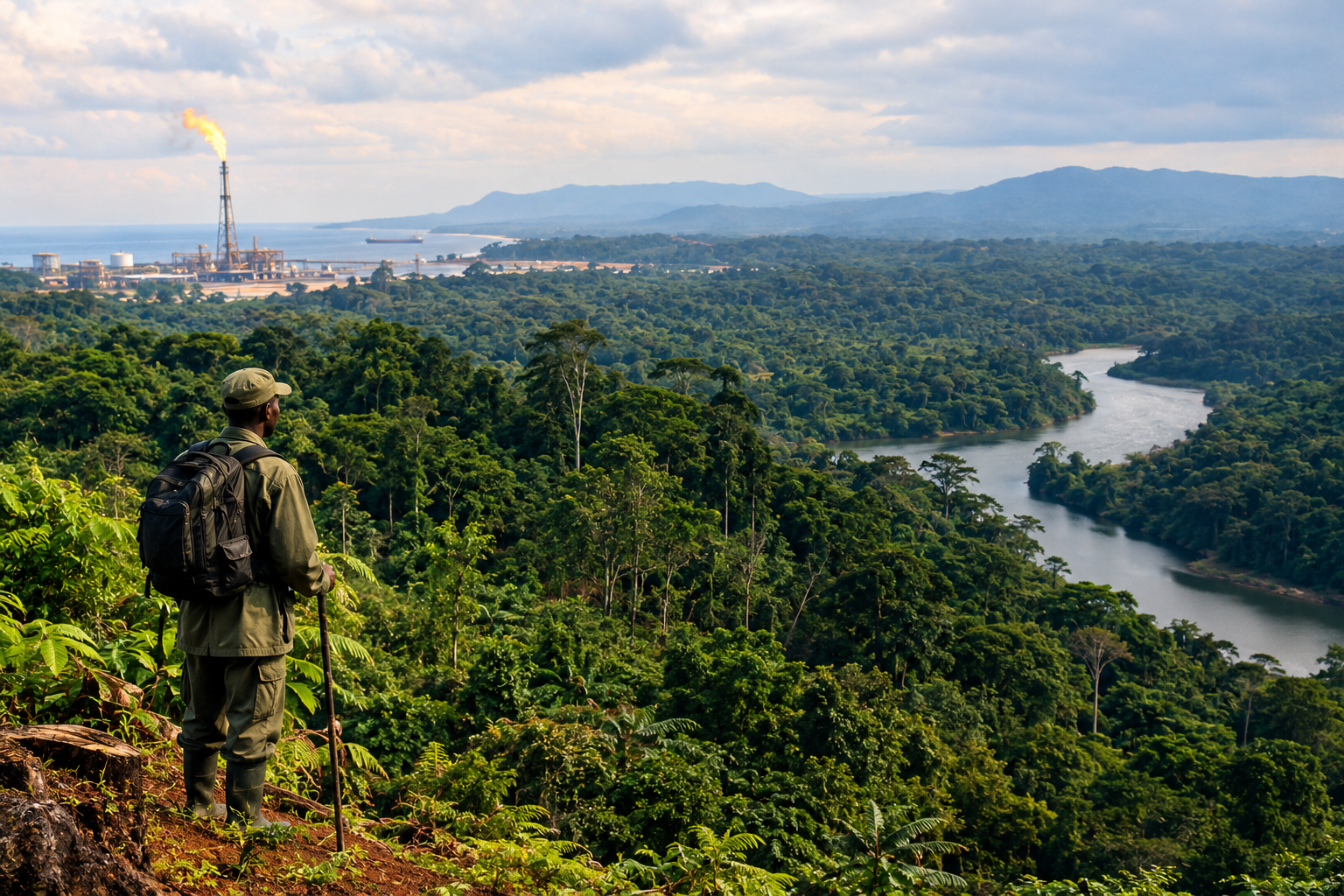
It is, at least partly, the forest.
The Asset That Built The Economy Is Running Down
The numbers explain why the question has become urgent.
The World Bank reported that Equatorial Guinea’s economy grew by an estimated 0.9% in 2024, while poverty reached an estimated 57% of the population living below $6.85 a day. The same report says hydrocarbons still accounted for more than 80% of government revenues and nearly 46% of GDP, even as the country’s non-renewable natural capital declined by 30% between 2005 and 2020.
Equatorial Guinea did convert part of its oil wealth into physical infrastructure. The World Bank estimates that produced capital increased 100-fold between 1995 and 2020, driven by public investment following the country’s oil and gas discoveries.
That matters because this is not simply a story about an oil-rich country failing to invest its resource wealth. It did invest. The problem is that physical capital and natural capital are not interchangeable. Roads, buildings and airports can survive the depletion of an oil field, but they cannot recreate the revenue stream that financed them.
The Bank’s argument is therefore about the country’s remaining balance sheet. If one major asset is declining, what other assets remain?
The Forest Is Valuable. The Market Is Not Ready.
Equatorial Guinea remains one of Africa’s most heavily forested countries. The World Bank’s 2025 update says forest cover fell from 97% of land area in 2000 to 94.5% in 2020, while the estimated annualised value of carbon-retention services reached $3.9 billion in 2020 and sediment-retention services added $45 million.
Those numbers need careful reading. The $3.9 billion is not revenue earned by Equatorial Guinea or a stock of readily saleable carbon credits; it is an estimate based on the annualised social cost of carbon. The Bank’s diagnosis is therefore not that the country has discovered a $3.9 billion income stream, but that it is preserving a globally valuable asset for which there is no comparably reliable payment mechanism.
That is the mechanism gap. Equatorial Guinea bears the costs of land management, enforcement and forgone extractive activity, while much of the climate benefit accrues outside its borders. The World Bank’s conclusion is explicit: the international community should scale up support and “fairly compensate” the country for the global carbon-retention services its forests provide.
Building The Pipeline
The country is not starting from zero. In January 2025, the Global Environment Facility approved a UNEP-implemented project to develop biodiversity and biocarbon-finance instruments, involving the Ministry of Forests and Environment, INDEFOR-AP and INCOMA; it combines a $4.13 million GEF grant with $34 million in co-financing.
The newer GCF intervention confirms that the next constraint is institutional capacity, not the biological existence of the forest. On 21 May 2026, the Fund approved an FAO-supported readiness proposal, “Consolidating readiness efforts to unlock access to GCF finance and scale impactful climate investments in Equatorial Guinea”.
The named decision-maker is the Minister of Forests and Environment, whose ministry is among the national institutions charged with translating forest policy into a financeable pipeline. The relevant test is whether the ministry and its implementing counterparts can establish credible measurement, land-use governance, benefit-sharing and fund-management systems before external buyers or results-based facilities are prepared to commit meaningful money.
The World Bank’s own carbon-market roadmap sets out the remaining barrier more bluntly: Equatorial Guinea is not yet ready to participate in either Article 6.2 or Article 6.4 mechanisms of the Paris Agreement. It still needs to complete the core Warsaw Framework requirements, including a technically assessed forest-reference level, an operational safeguards-information system, safeguards reporting and a biennial update report with a REDD+ annex.
The Missing Buyer
That is particularly difficult for a high-forest, low-deforestation country such as Equatorial Guinea. Mechanisms structured around measured reductions in deforestation can be less useful where forest cover remains extensive and historical deforestation is relatively limited.
The capital story is therefore not whether Equatorial Guinea’s forest has value; the World Bank has made that case. It is whether the government, GCF, GEF, UN agencies and prospective carbon buyers can build a credible route from valuation to verified payment — and at a scale that matters as hydrocarbon income declines.
