

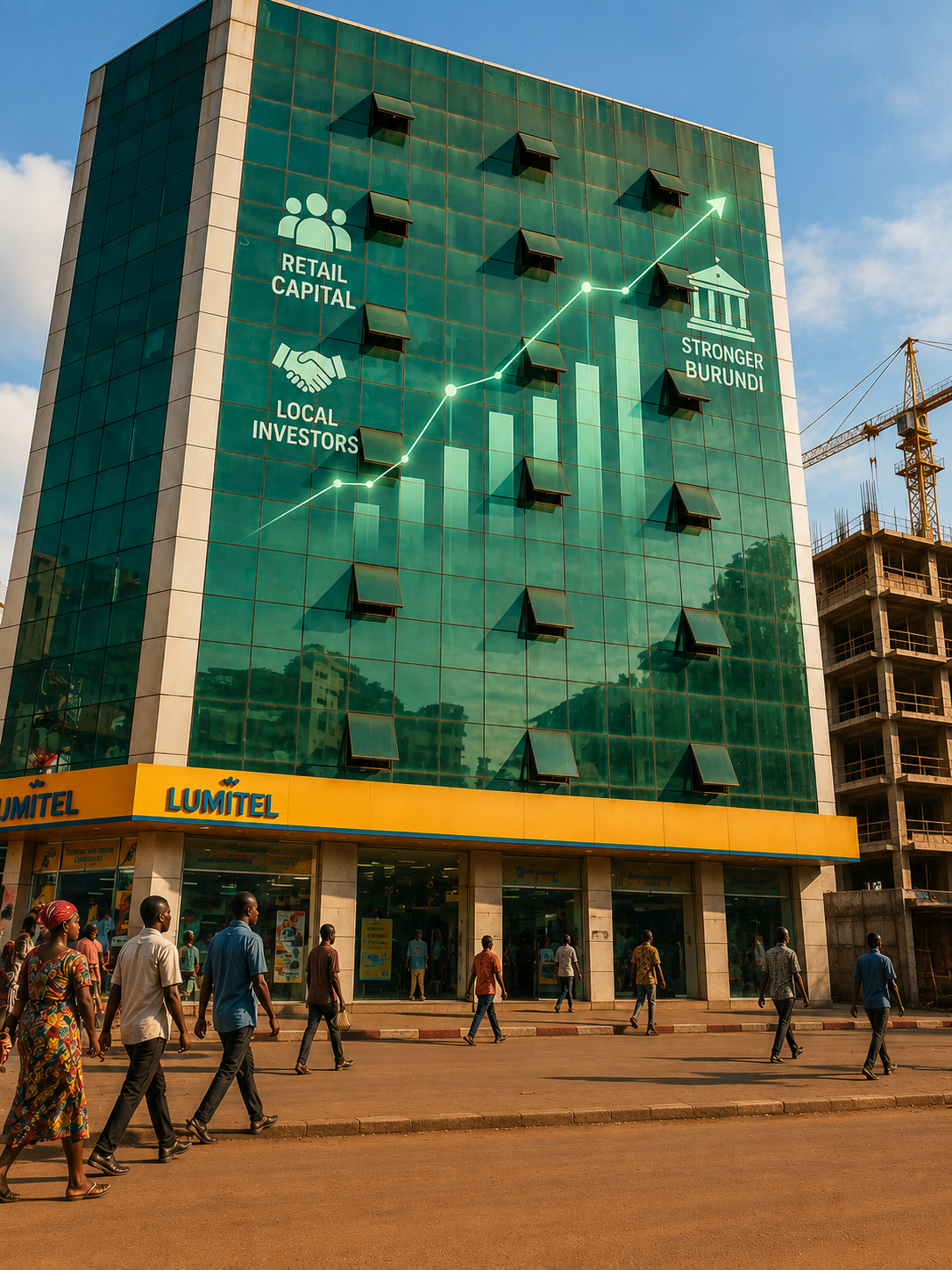
On 28 July 2026, One Africa Investment Fund (1AIF) opened the second subscription round for BUJA CITY PLAZA, a five-story commercial complex planned for the site of Bujumbura’s former central market. The unit price rose from BIF 103,000 (USD 103) to BIF 111,000 (USD 111), Phase 1 subscribers received an 8 percent bonus allocation on new units, and the fund set a three-month window to raise BIF 10 billion and USD 1 million.
Framed as a real estate story, this is a minor transaction. Framed as a capital-markets story, it is a test of something Burundi has never had: a repeatable mechanism for converting domestic savings and diaspora remittances into long-term infrastructure capital in a country with no functioning stock exchange and constrained access to sovereign borrowing.
The Mechanism: A Fund Standing In for a Bond Market
1AIF is registered as a variable-capital investment company—an approved Collective Investment Scheme (OPC/CIS)—managed by African Dream Assets (ADA) under Alain Gahama. Capital raised from investors flows into Ubaka Landmarks S.M., a mixed-economy special-purpose vehicle that holds the 27-year Build-Own-Operate-Transfer concession: three years of construction, 24 years of operation, then reversion of the asset to the state. Construction itself is contracted out at a fixed price to Ubaka Nation Group, which absorbs cost-overrun risk. BANCOBU serves as both depositary and registrar.
This is, in effect, a securitization of a single infrastructure asset, wrapped in retail-accessible units instead of institutional bonds. Ninety percent of raised capital goes directly into construction; the remaining 10 percent sits in short-term instruments capped at 360 days’ maturity and 30 percent exposure to any single bank—a liquidity buffer against redemption requests in a market with no secondary exchange to absorb them.
The state’s role is structural, not symbolic. The Banque d’Investissement pour les Jeunes (BIJE) supplied 60.91 percent of seed and acceleration capital, and Presidential Decree No. 100/057 of 9 April 2026 seated seven state representatives on Ubaka Landmarks’ board—including the director-general of the capital markets regulator itself, Dr. Arsène Mugenzi. The arrangement lets the government secure a landmark commercial asset without adding to public debt while keeping direct oversight of how private capital is deployed on state land.
Why Now, and Why This Way
The state could not fund reconstruction of the market directly after its destruction; conventional options—sovereign borrowing or a bank-syndicated private placement—were either unavailable or would have excluded the retail and diaspora savings pools the fund was explicitly designed to capture. The dual-currency structure is the clearest evidence of that design intent: BIF and USD subscriptions are held in segregated BANCOBU accounts, and USD-denominated distributions are contractually tied to USD-denominated subscriptions. That is a formal attempt to pull diaspora remittances into productive, longer-duration capital rather than consumption or informal transfer channels—in an economy that runs chronic foreign-exchange shortages.
Regulatory sequencing tells its own story. The Burundi Capital Market Regulatory Authority (ARMC) required the promoter to convert into a Société Anonyme before it would issue a visa, imposed mandated risk disclosures on concentration and valuation methodology, and retained approval rights over both secondary unit transfers and any co-investment with foreign entities. For a market with no listed equities, ARMC’s approval — Notice ARMC/DG/372/2026, dated 20 July 2026 — functions less like a routine regulatory filing and more like the market’s first stress test of institutional governance.
The Investor Arithmetic
The fund advertises annual returns of “no less than 8 percent” once the complex is operational, a 15-year payback period, and a cumulative cash-flow target of 192 percent of initial capital over the concession term.
Project initiator Fablice Manirakiza has framed the pitch to prospective subscribers in blunter terms: “As investment increases, so do the expected returns.”
Set against that is a fee load that is not trivial for a retail product: a 3 percent entry charge, a combined 3 percent annual management and governance fee, and a 25 percent performance fee on returns above the 8 percent hurdle. For domestic banks and insurers, the comparison that matters is the roughly 8 percent yield available on Burundi Treasury Bills—the fund is pricing itself as a like-for-like alternative, with construction, tenancy, and currency risk layered on top rather than a clean liquidity premium.
One detail is worth flagging for anyone underwriting Phase 2. At the 28 July 2026 launch, Diomède Miburo, representing 1AIF, told journalists that Phase 1 had attracted 5,638 investors and mobilized “more than BIF 5 billion,” alongside separate dollar-denominated investments. The fund’s own capital reporting puts the same round, from the same 5,638 investors, at BIF 3.35 billion plus USD 348,513 — a materially lower BIF figure than the one stated publicly at launch, even accounting for the dollar tranche. The gap may reflect rounding, a different cut-off date, or a different basis of calculation, but it is the kind of discrepancy institutional allocators typically resolve before, not after, committing capital to a follow-on round.
Where the Risk Sits
Liquidity is the binding constraint. With no secondary exchange, exit is limited to peer-to-peer OTC transfers requiring ARMC “no objection” approval within a week or fund-level redemption penalties that scale from 8 percent in year one to 3 percent in year three. A wave of early redemptions would test the 10 percent liquidity buffer quickly.
Currency risk cuts against the USD tranche specifically: commercial rents will be collected predominantly in BIF, and the prospectus does not guarantee FX coverage if the mall’s hard-currency revenue—international tenants and diaspora-linked services—falls short of projected USD distributions. And the entire 15-year payback model rests on a 36-month construction timeline and achieved occupancy; a fixed-price EPC contract transfers cost-overrun risk to the contractor but not the risk of a lower-than-model discount rate if completion slips.
What the Model Would Prove, and What Would Undo It
If Phase 2 closes on schedule and construction proceeds within budget, BUJA CITY PLAZA becomes a template rather than a one-off: the same CIS architecture—retail micro-tickets, dual-currency tranches, a state-anchored SPV, and fixed-price EPC risk transfer—could in principle be applied to ports, energy assets, or agro-processing plants where Burundi’s sovereign borrowing capacity is exhausted. That would matter beyond Burundi’s borders.
The regional contrast is instructive: Kenya’s Capital Markets Authority approved ALP iREIT, East Africa’s first industrial income REIT, in December 2025, and the Private Infrastructure Development Group anchored it with a Sh1.95 billion (USD 15 million) investment the following month—a DFI backing a listed, exchange-traded vehicle in a market that already has one. Burundi has no exchange to list on, so 1AIF is attempting to build the retail mobilization function of a REIT without the liquidity infrastructure that normally underwrites it.
A regulated vehicle that actually distributes cash to retail and diaspora holders would narrow that gap and lower the perceived governance risk of the structures that follow it; regional DFIs have historically treated Burundi as a peripheral allocation for exactly this reason. A stalled construction timeline or a missed distribution would reinforce the existing preference for larger, more liquid East African markets instead.
The number worth tracking is not the size of Phase 2’s raise. It is whether Ubaka Landmarks S.M. produces its first audited NAV report on schedule and whether the fund’s own disclosed capital figures for Phase 1 are reconciled before that report is issued. A frontier capital-markets regulator’s credibility is built less on the size of the deals it approves than on the consistency of the numbers behind them.
