

Nigeria spent the first half of 2026 telling investors, in four unrelated markets, the same thing: yield now, growth later. You can see it in the money that actually crossed the border, in what the central bank chose not to do, in who’s writing checks to startups, in one oil ministry meeting nobody outside Abuja paid attention to, and in a strategic investor buying its way into the country’s payment rails.
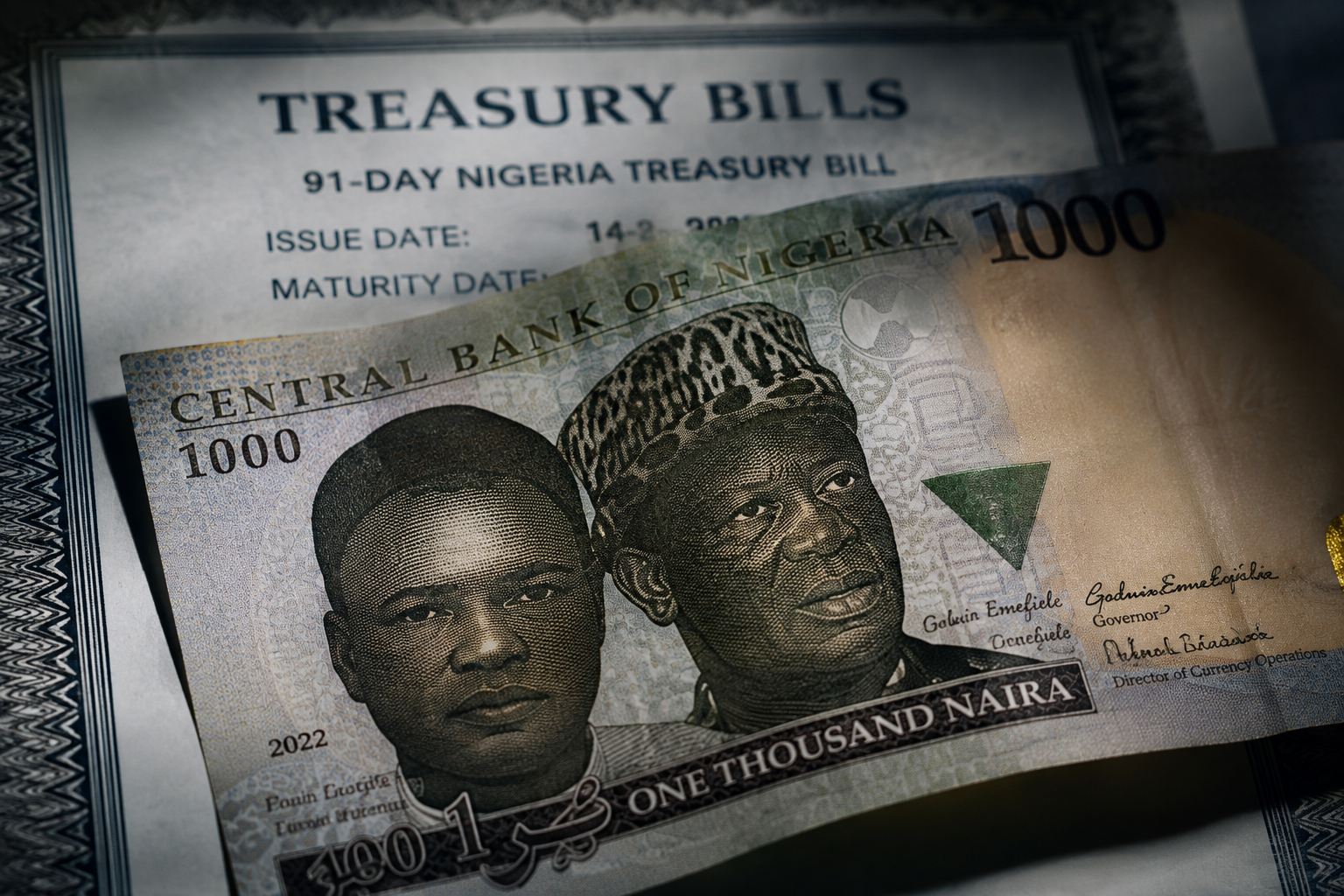
Start with the border crossings, because they’re the cleanest signal. The National Bureau of Statistics’ Capital Importation Report for Q1 2026 put total capital inflows at $10.37 billion between January and March — an 83.83% jump on the $5.64 billion recorded in Q1 2025. Portfolio investment accounted for $9.86 billion of that, or 95.09%, with money market instruments alone pulling in $6.50 billion, per the same NBS release. Foreign direct investment — capital that builds something rather than lends against something — came in at just $135.08 million, or 1.3% of the total. Nigeria didn’t attract investment this half. It attracted yield.
That’s not an accident of the market; it’s the direct product of a policy choice. The Central Bank of Nigeria’s Monetary Policy Committee, at its 306th meeting on 20–21 July, voted to hold the benchmark rate at 26.5% for a second consecutive sitting, alongside an unchanged Cash Reserve Ratio of 45% for deposit money banks. Governor Olayemi Cardoso explained the logic in the post-meeting communiqué:
“The committee’s decision to maintain the current policy stance followed a thorough assessment of the balance of risks. Although headline inflation moderated marginally in June 2026, global uncertainties have heightened, mainly due to the renewed hostilities in the Middle East… maintaining a cautious monetary policy stance remains appropriate.”
Headline inflation had eased only from 15.93% in May to 15.91% in June — barely enough to justify easing, and Cardoso chose not to. The IMF described why that caution runs deep in a Selected Issues Paper accompanying Nigeria’s latest Article IV consultation — “Nigeria’s Shift to a Floating Regime: Interest Rate and Exchange Rate Pass-Through and Policy Effectiveness,” IMF Selected Issues Paper No. SIP/2026/045, published 17 June 2026 which found Nigerian lending rates follow what the Fund called a “rockets-and-feathers” pattern, rising quickly when the CBN tightens but falling only slowly when it eases.
That transmission lag is itself a policy fact worth sitting with — it means the carry trade’s economics don’t reset the day the CBN eventually cuts, which is exactly what makes Nigeria’s development-finance exposure worth a closer look now rather than waiting for H2.
Two of the continent’s biggest DFIs are positioned on opposite sides of that same rate environment. The IFC’s local-currency partnership with the CBN, signed in 2024 and still active through this half, gave it a Nigerian portfolio of up to $2.13 billion — its second-largest country exposure in Africa — with a stated goal of pushing past $1 billion in fresh local-currency financing specifically to get Nigerian borrowers off dollar debt and out of currency-mismatch risk.
In May, the IFC extended that logic with a $500 million local-currency facility alongside Access Bank, announced at the Africa CEO Forum in Kigali. Afreximbank sits on the other side of the same dynamic: its 2024 Annual Report recorded net income up 28.7% year-on-year to $973.5 million, which the bank’s own leadership credited to growth in business volumes “supported by higher market interest rates” across its African markets, Nigeria included (Afreximbank, Annual Report 2024, p. 9; full financial discussion at pp. 108–116) — the multilateral lender that’s supposed to be catalytic capital was, in dollar terms, a beneficiary of the same high-rate environment squeezing ordinary Nigerian borrowers.
Put those two next to each other and the DFI desk’s actual read on Nigeria isn’t simple. One major DFI is racing to build local-currency instruments precisely because dollar-linked lending at 26.5% is unsustainable for Nigerian SMEs; another is quietly booking record income off the same rates. Both readings are correct, and both explain why development finance, not just commercial capital, has real skin in whatever the CBN does next with the benchmark rate.
Venture tells a version of the same story, though the number worth leading with isn’t the biggest one. Nigeria raised $214 million in pure equity funding in H1 2026 — Africa’s largest, ahead of Egypt’s $183 million — and $254 million including debt, according to Africa: The Big Deal’s “H1 2026: Mapping the Money” report, published by Max Cuvellier Giacomelli on 20 July 2026.
That’s a real comeback after a rough 2025, when the country raised barely $343 million across the whole year. But a large share of the rebound rode on one month: continental equity funding hit $468 million in June alone, the best single month since March 2022, and Nigeria caught that wave harder than any other market, largely on the back of Flutterwave’s roughly $100 million Series E. Strip the mega-rounds out and the picture underneath is thinner and more selective than the headline suggests — which is the same story this desk has now tracked in Ghana and elsewhere: capital concentrating into fewer, larger, later-stage deals while the smaller end of the pipeline goes quiet.
That’s the gap a much smaller, blended facility spent the year trying to close. Cascador, a Lagos-based accelerator, partnered with Sterling Bank in May 2025 on the Cascador Catalytic Fund, deploying roughly $5.63 million across seven companies at its 2026 Pitch Day — three orders of magnitude smaller than the Ripple deal below, and that gap in scale is itself the point. Sterling Bank’s CEO, Abubakar Suleiman, described the intent at launch as capital “designed around the realities of building a business in Nigeria,” with the Nigeria Sovereign Investment Authority and the Development Bank of Nigeria sponsoring alongside it — patient capital operating at a size the mainstream market has priced out entirely.
Oil is where the government made its own bet, and it made it quietly, months before the half even started. On 3 December 2025, the Federal Executive Council approved the 2026–2028 Medium-Term Expenditure Framework, and the assumptions behind it tell you exactly how much the government trusts its own upside. Minister of Budget and Economic Planning Atiku Bagudu told reporters the Council adopted a production target of 2.06 million barrels per day for 2026 — the figure the industry is being pushed to hit — but based the actual budget on a far more conservative 1.8 million barrels per day, alongside an oil price benchmark of $64.85 and an exchange rate assumption of ₦1,512 to the dollar. Bagudu was candid about why the naira assumption ran weaker than where the currency was actually trading: “the exchange rate assumption took into account the fiscal outlook ahead of the 2027 general elections.” That’s a government hedging its own optimism in writing, in a document the Senate then had to deliberate on.
On the production side, there’s real momentum behind the higher number: NNPC’s Group CEO, Bayo Ojulari, disclosed in the company’s One-Year Mandate Report at the end of April that crude output had reached 1.71 million barrels per day between April 2025 and April 2026, the highest in five years, with NNPC’s own upstream subsidiary, NNPC Exploration and Production Limited, hitting an all-time peak of 565,000 barrels per day in December 2025 (some earlier framing of this story has attributed that record to NNPC Upstream Investment Management Services, a related but distinct entity managing the group’s joint-venture interests — the record belongs to NNPC E&P specifically, per NNPC’s own disclosure and independent reporting from Channels Television and Businessday).
Production is outrunning the government’s own budget math, and Abuja is still choosing to bank the conservative number — the same instinct that had the central bank holding rates and the Cascador fund working around the edges of a market gone selective.
The half’s single largest signal, though, came from neither the central bank nor the oil ministry — it came from a strategic investor buying its way into Nigeria’s payment rails. Flutterwave closed its Series E on 16 June at a $3.25 billion valuation, anchored by a strategic investment from Ripple, the US blockchain payments firm. Neither company disclosed the size of Ripple’s stake, but the deal embeds Ripple’s RLUSD stablecoin, its payments network, and the XRP Ledger directly into Flutterwave’s infrastructure and its Send App remittance corridors. In the companies’ joint announcement,
Agboola said:
“This investment marks a pivotal moment in our journey, enabling us to significantly scale our infrastructure and expand our stablecoin-enabled payments roadmap. By unlocking faster settlement and lower-cost cross-border payments, we are building a payment superhighway that connects African commerce directly to the global economy. This partnership is a catalyst for Nigerian and African sovereignty in the digital financial age, ensuring our markets are primary participants in the global digital asset revolution.”
Read plainly, that’s not a bet on Flutterwave’s transaction growth. It’s a bet on who controls the settlement layer underneath it — Ripple bought distribution, not upside.
Put all of it together and Nigeria’s H1 2026 vote is hard to miss. The central bank chose to hold rates and let yield carry the currency, and 95% of the capital that answered was portfolio money chasing exactly that yield. One DFI raced to build local-currency alternatives to that same dynamic while another quietly profited from it. Venture capital concentrated into fewer, larger, later-stage rounds while a small blended facility did the unglamorous work of financing the tier underneath. The government budgeted against its own best-case oil number rather than trust it. And Ripple paid for Flutterwave’s regulatory footprint and settlement position, not its growth story. None of this is a bet on Nigeria’s old growth narrative — a rising consumer class, a demographic dividend.
It’s a narrower bet: that Nigeria can manage risk well enough, and hold its rails steady enough, that yield-seeking and infrastructure-seeking capital keeps showing up even while growth-seeking capital stays cautious. Whether the CBN can start easing without breaking the carry trade currently doing the work of currency stability is the question the second half will actually answer.
