

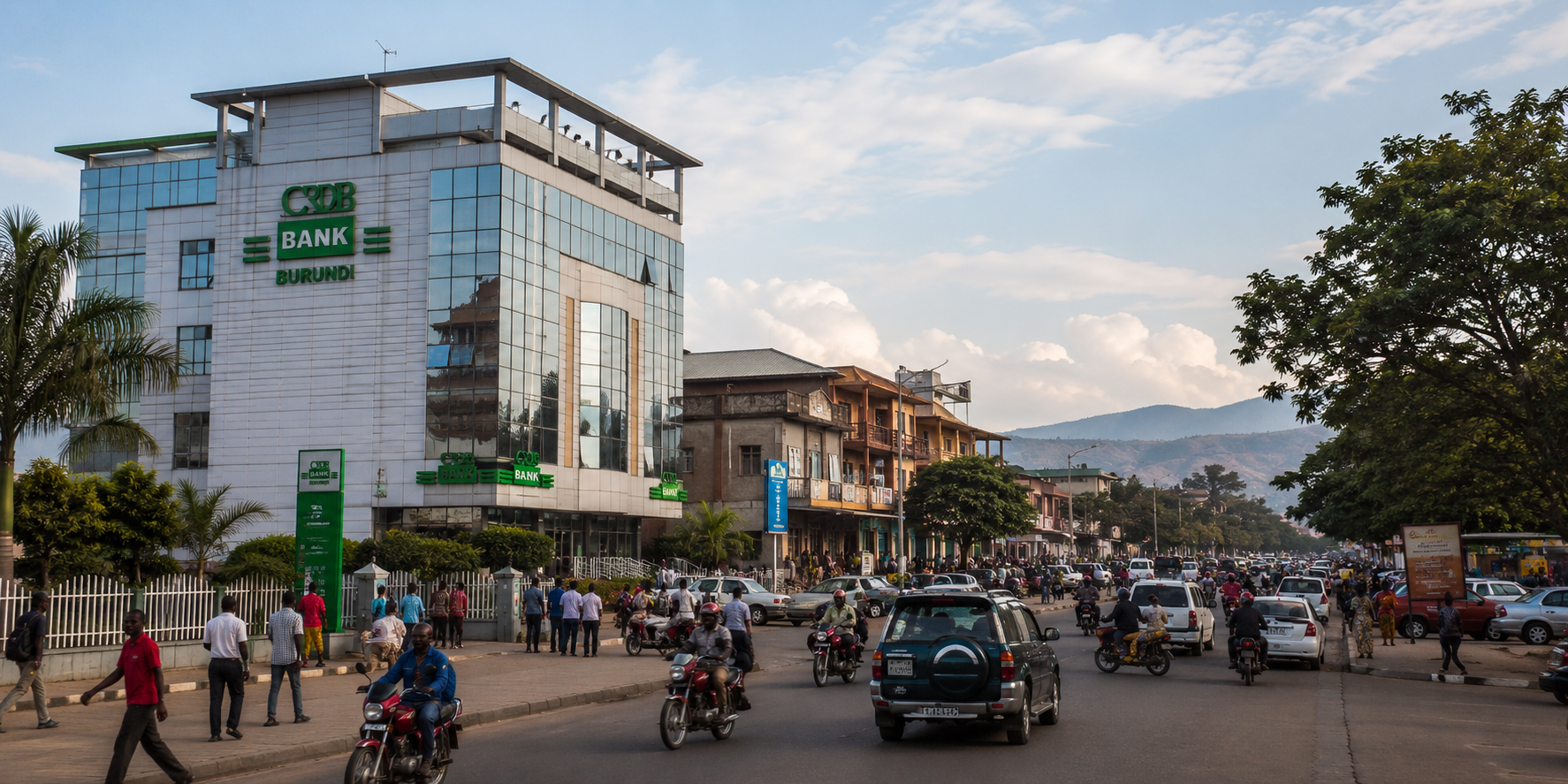
One name worth knowing before the numbers below: Cooperative and Rural Development Bank (CRDB) Burundi, the local lender IFC picked as its re-entry point after the 2022 CPSD — the clearest evidence of what a bankable counterparty looks like in this market, and how rare it still is.
Why This Ranking Looks Different
Every DFI ranking or capital-flow piece this desk has run so far — Ghana, Nigeria, Senegal — has involved weighing competing pools of capital: DFI money against commercial venture capital, concessional debt against Eurobond markets, foreign inflows against domestic pension mobilization. Burundi doesn’t offer that comparison, and pretending otherwise would misrepresent the market.
There is effectively no disclosed private impact-investing or venture activity in-country at meaningful scale, no active local capital markets story, and no competing commercial capital pool to set development finance against. What follows is closer to a ranking of who funds Burundi’s public balance sheet at all, using each institution’s own disclosed, in-country commitment figures. That’s a narrower exercise than TACR’s other rankings, and it’s worth saying so upfront rather than dressing up a thin market as a competitive one.
- World Bank Group — $1.8 Billion
The World Bank Group is not close to the largest development partner in Burundi; it’s in a different category entirely. Per the Bank’s own Burundi country page, the current portfolio comprises 14 national projects and 3 regional projects for a combined $1.8 billion, funded through the International Development Association — IDA, the Bank’s concessional-lending arm for the world’s poorest countries.
The sectoral breakdown tells you where that money actually goes: infrastructure (31.5%), people — meaning health, education, and social protection (33.2%), planet (11.6%), digital (5%), prosperity (14.3%), and poverty-targeted programming (1.1%).
A new Country Partnership Framework covering 2026–2031 is in preparation, explicitly designed to better integrate the World Bank’s sovereign lending with IFC and MIGA activity — an acknowledgment, built into the Bank’s own planning language, that those two arms currently operate at a scale barely worth integrating.
- African Development Bank Group — UA 373.4 Million
AfDB’s active Burundi portfolio, per its own 2025 Country Portfolio Performance Review, stood at 19 public sector projects and one non-sovereign project for total commitments of UA 373.4 million as of April 2025. AfDB’s Unit of Account is defined, by the Bank’s own charter, as equivalent to one IMF Special Drawing Right (SDR).
IMF SDR-to-dollar rates through 2024 and 2025 ran in a fairly narrow band, generally between roughly $1.30 and $1.37 per SDR based on the Fund’s published monthly archives — which would put UA 373.4 million at somewhere between roughly $485 million and $512 million. TACR could not confirm the precise SDR/USD rate for the specific date AfDB used in compiling its April 2025 portfolio figure, so the ~$500 million estimate carries that imprecision and should be read as a band, not a point figure.
The same review is unusually candid about where the portfolio is straining: it flags persistent disbursement bottlenecks and describes a new Country Portfolio Improvement Plan for 2025 as necessary to fix implementation delays that a prior review, in May 2023, had already identified.
AfDB’s operational focus in Burundi splits across four of its “High 5” priorities — Integrate Africa (43% of the portfolio), Feed Africa (24%), and Light Up and Power Africa (23%) account for the bulk of it. The Bank’s own report names the European Union as Burundi’s “privileged partner,” specifically on co-financed energy and transport projects — which is the clearest on-record evidence of how thin the field of serious co-financiers actually is.
- European Union — Co-Financier, Not Solo Actor
The clearest recent evidence of the EU’s active role is a joint AfDB-EU-government inspection of the Port of Bujumbura rehabilitation in March 2025, where the EU is financing 43% of a roughly €45.25 million project (AfDB covers 52%, Burundi’s government the remaining 5%) — infrastructure serving Lake Tanganyika regional trade.
On the national envelope, the current, verifiable figure is the EU’s own Multiannual Indicative Programme for Burundi under NDICI-Global Europe: €194 million allocated for the programme’s first segment, 2021–2024, per the EU Delegation’s own country page — not the older €210.7 million figure tied to an earlier EDF cycle that TACR previously flagged as unreliable.
Add the roughly €83 million Brussels has separately mobilised for regional projects targeting Burundi, and the EU’s total disclosed envelope runs to approximately €277 million, or just under $300 million at current rates — a real, serious third position, well behind the two multilaterals above it but a genuine bilateral commitment rather than a rounding error.
- IFC — $28 Million, And The Gap That Matters
The International Finance Corporation, the World Bank Group’s private-sector arm, is where the ranking gets genuinely revealing rather than just sequential. Per the World Bank Group’s own Burundi partner page, IFC’s committed exposure in-country totals $28 million — $20 million supporting the banking sector’s ability to lend to small businesses and traders, and $8 million backing feasibility work for energy production and distribution.
Set against IDA’s $1.8 billion, IFC’s Burundi book is roughly 1.5% the size, and it’s shrinking, not holding steady: a World Bank Group document (Report No. 181794-BI, a Performance and Learning Review covering the Burundi Country Partnership Framework) states that “as of December 31, 2022, IFC’s total committed portfolio in Burundi was US$38 million.” Three years of relationship-building and one dedicated diagnostic later, the book is smaller, not larger.
That same document names the one deal that actually shows what a bankable Burundian counterparty looks like. In November 2022, IFC signed a $5 million credit line with the Cooperative and Rural Development Bank (CRDB) Burundi for SME lending — explicitly built on the findings of that year’s Country Private Sector Diagnostic, and notable because it was IFC’s first new commitment in the country since 2012.
A single local bank, chosen after a decade-long gap, is the closest thing this market has to a proof point that IFC can find something to underwrite here. The pipeline built on top of it — agribusiness, financial sector, mining, infrastructure — is still mostly studies and feasibility work rather than signed capital.
That gap isn’t just a TACR read of two disclosure pages sitting next to each other — it’s one the World Bank’s own leadership names directly, and building backward from what they’ve actually said points to why. Babacar Sedikh Faye, appointed World Bank Group Country Manager for Burundi in July 2025 with responsibility across IBRD, IDA, IFC and MIGA, said in his own appointment statement that the WBG “is also convinced that this will require sustained support for the emergence of a dynamic private sector that drives inclusive and sustainable growth.”
His predecessor, Hawa Cissé Wagué, said essentially the same thing three years earlier, at the 2022 launch of the IFC-World Bank Country Private Sector Diagnostic (CPSD) for Burundi: the WBG was “optimist that Burundi will undertake the needed macroeconomic and structural reforms to attract more domestic and international private investments.” Two country managers, three years apart, naming the identical unresolved problem is itself evidence of how structural the barrier is — this isn’t a gap closing on a normal timeline.
The CPSD itself, jointly authored by IFC and the World Bank, is the most direct account of why IFC stays small. It names state-owned enterprises as crowding out space for private actors, and recommends reforming them specifically to make room for competitors. It flags Burundi’s financial sector as missing basic infrastructure IFC needs to underwrite against at scale — no shared banking platforms, no National Payment Council, thin credit information systems.
The U.S. State Department’s 2024 Investment Climate Statement adds the mechanism that makes currency risk concrete: an “artificially low official exchange rate” that it calls “a prohibitive constraint to private investments,” meaning any dollar-denominated IFC facility has to price in a currency regime that doesn’t reflect market reality.
And informality does the rest of the work: Faustin Ndikumana, national director of the Burundian civil society group PARCEM, told local media in 2025 that “the private sector is currently in distress,” noting that more than 70% of Burundi’s economy operates informally — which is a direct problem for an institution like IFC that lends against audited balance sheets, not cash transactions nobody records.
Layered on top of all of that is the political environment IFC’s own risk models have to price. Burundi’s National Assembly is not a genuinely contested legislature — the ruling CNDD-FDD party holds 100 of 103 seats following the 2025 election, with the next presidential vote not due until 2027. That’s not incidental background; it’s part of what a private-markets lender is pricing when it decides how much capital a market can absorb.
IDA’s mandate is built to lend into exactly this kind of environment regardless — Burundi qualifies for IDA’s Fragility, Conflict and Violence window specifically because of documented instability, including roughly 410 conflict-related deaths in 2022, per the World Bank’s own project documentation. IFC has no equivalent mandate to absorb that risk; it’s supposed to find bankable deals despite it.
The $1.8 billion versus $28 million gap, read this way, isn’t really two institutions succeeding and failing at the same job. It’s one arm of the World Bank Group doing what it exists to do in a fragile state, and the other arm confirming, deal by deal, that the private-sector conditions its own mandate requires still aren’t there.
A Note On TDB Group — Headquartered There, Not Necessarily Invested There
One institution deserves a separate mention rather than a ranked slot, because its relationship to Burundi doesn’t fit a simple capital-committed comparison. The Eastern and Southern African Trade and Development Bank — TDB, formerly the PTA Bank — is dual-headquartered in Bujumbura and Ebène, Mauritius, with roughly $8 billion in group assets as of 2022, per its own disclosures.
That headquarters fact makes Burundi TDB’s home address. It does not make Burundi a major destination for TDB’s actual lending, which runs across 22 African member states through COMESA, the EAC, and SADC, operationally centred out of TDB’s regional office in Nairobi.
The clearest disclosed example of TDB capital actually reaching a Burundian institution is a trade-finance facility extended to Bancobu, Burundi’s leading commercial bank, to support agro-exporting SMEs in tea, coffee, and other commodities — announced as “multi-million dollar” without a disclosed figure. TDB Group Managing Director Admassu Tadesse marked the signing by noting Bujumbura is “where TDB has one of its principal offices” — a statement about geography, not about capital concentration.
The lesson for anyone reading a DFI’s address as a proxy for its commitment to that market: check the portfolio, not the letterhead.
What This Ranking Actually Shows
Ordered by disclosed in-country commitment, the sequence is World Bank Group, then AfDB, then the EU, with IFC a distant fourth that exists mainly to measure how absent private-markets capital still is. The real finding isn’t the order — it’s that IDA’s mandate is designed to substitute for exactly the private capital IFC’s own diagnostics say Burundi hasn’t yet made investable.
