

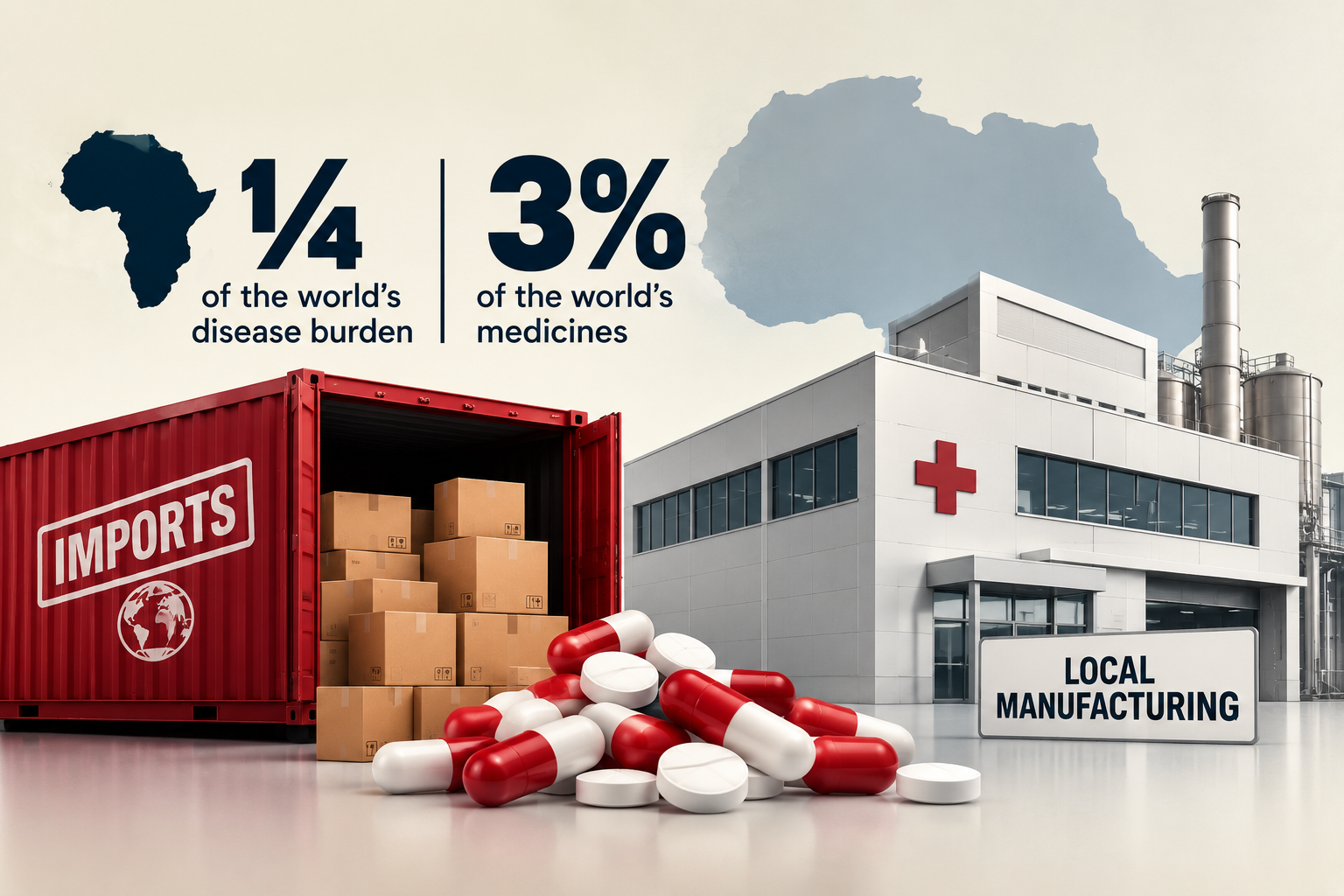
Sit with that gap for a second.
We’ve all heard the version that goes, “Africa needs more healthcare investment.” That’s true. But it’s not the interesting part. The interesting part is narrower — and sharper: the demand is here. Undeniably. Permanently. Growing. The manufacturing isn’t.
And whoever closes that specific gap? They’re not doing charity. They’re building one of the more durable businesses on the continent.
I keep coming back to the same three numbers. Africa imports more than 70% of the medicines it consumes. More than 95% of the active pharmaceutical ingredients that go into whatever is made locally. Those figures came from Anthony Ameka, CEO of the Federation of Africa Medical Equipment, Disposables and Devices Manufacturers and Suppliers (FOAMEDDMS), speaking at the 5th West Africa Pharma and Healthcare Expo in Accra this June.
And on vaccines — the thing that actually decides who lives through the next outbreak — the European Union’s Team Europe health initiative (materials reviewed September 2025) puts the number at over 99%. Ninety-nine percent. We don’t manufacture immunity. We import it.
We’ve Seen This Movie Before
A continent that supplies the raw input and pays someone else for the finished good isn’t a new African story. We’ve lived it in cocoa. In cotton. In crude.
But here’s what makes pharma different — what makes it worth its own conversation rather than a footnote in the commodities story: this isn’t really a raw-material problem. Africa doesn’t lack the ingredient. It lacks the factory. The regulator. The procurement system that would let a factory survive.
That’s a solvable problem. And solvable problems? That’s where the money goes.
What Actually Happened When the Shelves Went Empty
COVID didn’t create this dependency. It just made it impossible to ignore. When India and China closed their export windows to protect their own populations, African countries didn’t get to negotiate. They waited.
Dr. Jean Kaseya, Director-General of Africa CDC, has taken to calling local pharmaceutical manufacturing “the second independence of Africa.” I don’t think that’s an exaggeration for effect. I think it’s the correct scale of the problem.
Since then, the continent set itself a real target — not a slogan: 60% of its own vaccine needs manufactured locally by 2040. Today? We’re at under 1%.
That’s either a depressing gap or the size of the opportunity. Depends which side of the balance sheet you’re sitting on.
Where the Building Is Actually Happening
A few data points — four specific ones — that tell you this isn’t purely aspirational anymore.
Rwanda got Africa’s first end-to-end mRNA facility — a $145 million build with BioNTech — up and running in Kigali. It’s not just a ribbon-cutting; the facility is already training regional scientists on mRNA platform technology.
Egypt became the first African country to hit WHO Maturity Level 3 for its medicines regulator — the credential that lets a country’s manufacturers get taken seriously by global buyers. They paired that milestone with locally made insulin, proving regulatory sophistication unlocks product complexity.
South Africa’s Aspen Pharmacare — the continent’s largest pharma company — is running a “Manufacturing in Africa for Africa” push with a €500 million joint financing package from IFC, Proparco, DEG, and the U.S. DFC, aimed squarely at insulin and paediatric vaccines. This matters because the World Health Organization’s Africa region shows diabetes cases rising from roughly 19 million in 2019 to a projected 47 million by 2045.
And in Ghana, Atlantic Life Sciences is scaling local output of essential medicines while eyeing a move into antiretrovirals and vaccines — the kind of step-by-step climb up the value chain that, if it works, is the actual template for everyone behind them.
None of these are the finished story. All of them are proof that the capital and the technical partners are willing to show up when the structure is right.
The Honest Caveat
I’d be doing this thesis a disservice if I didn’t mention the skepticism — because it’s coming from inside the industry, not from outside critics. Stavros Nicolaou — Aspen Pharmacare’s Group Senior Executive for Strategic Trade and chair of Pharmaceutical Manufacturers in South Africa — told a plenary session at the Conference on Public Health in Africa (CPHIA) 2025 in Durban this past October that Gavi’s $1.2 billion African Vaccine Manufacturing Accelerator, the flagship financing vehicle for exactly this ambition, was “not fit for purpose” in its current form.
His specific complaint, later confirmed to Health Policy Watch: the money is earmarked mainly for “fill-and-finish” manufacturers rather than the harder, more valuable upstream work. That distinction is worth spelling out, because it’s doing real work in this argument.
Fill-and-finish takes a bulk drug substance or antigen someone else already made and handles the last mile — formulating it, filling vials, packaging, labelling. It’s real manufacturing, but the technical and regulatory bar is comparatively low — which is exactly why roughly 40% of Africa’s existing pharmaceutical manufacturing capacity sits there, according to an African Development Bank (AfDB) industry assessment.
Producing the active ingredient itself — the actual chemistry or biology — requires specialised fermentation or synthesis capability, deep quality-control infrastructure, and typically years of technology-transfer negotiation with the originator company that holds the process know-how. That’s the layer only a handful of facilities on the continent can currently do at all. It’s also the layer that determines whether a country is manufacturing medicine or just repackaging someone else’s.
Overcapacity is a real failure mode here — not just under-investment. Worth naming precisely: the Clinton Health Access Initiative’s report, “Current and planned vaccine manufacturing in Africa” (November 2025), found that if every currently announced fill-and-finish vaccine facility on the continent gets built, Africa’s combined capacity would end up more than double its projected 2030 demand.
That’s not a reason to look away from this. It’s a reason to be precise about where in the value chain the actual opportunity sits.
Fill-and-finish is getting crowded. Active pharmaceutical ingredient production is not. Neither is the regulatory and procurement infrastructure that determines whether any of these factories can sell profitably once they’re built.
What I Think This Actually Is
Strip away the health-sovereignty language — which is real and matters — and you’re left with a straightforward structural read:
A $20.8 billion pharmaceutical market in 2013 heading toward $50 billion or more by 2030, sitting on top of demand that isn’t going anywhere — figures the Brookings Institution documented in its analysis, “Realizing Africa’s pharmaceutical potential.”
The International Finance Corporation’s 2025 report, “Answering Africa’s Call for Private Investment in Pharma Manufacturing”, puts a specific number on the industry piece of that build-out: $11 billion needed by 2030 to develop Africa’s pharmaceutical manufacturing capacity specifically — a slice of a much larger $111 billion vision that includes roughly $100 billion for the regional logistics and infrastructure needed to move products once they’re made.
The African Development Bank itself is considering committing up to $3.1 billion of that through 2030, according to its Pharmaceutical Industry Investment Roundtable concept note.
That’s not a donor-dependent number. That’s a market-sized number — with the institution doing the estimating also putting real capital behind its own math.
Here’s why I’m confident about the API layer specifically: I’ve sat in deal rooms where multinational originators quietly acknowledged they’d rather transfer API technology to a well-capitalized African partner than watch that margin slip to generic competitors in Asia — but only if the regulatory pathway and off-take guarantees are locked in first. That’s the kind of conversation a desk researcher never hears.
The founders and operators who figure out the unglamorous middle of this — the API plants, the regulatory pathways, the procurement relationships, the cold-chain logistics that get a vaccine from a Kigali or Dakar facility to a clinic three countries away — are building something that a lot of the mineral and fintech infrastructure plays don’t have: a customer base that cannot opt out.
People will keep getting sick. Governments will keep needing to procure medicine. The only open question is whether the margin on meeting that need sits in Mumbai and Shanghai — or starts sitting here.
One more thing: the API layer — capital-intensive, long-payback, strategically critical — is sized for development finance institutions and sovereign industrial capital, not private equity’s typical five-to-seven-year horizon.
That’s the bet I’d be watching.
