

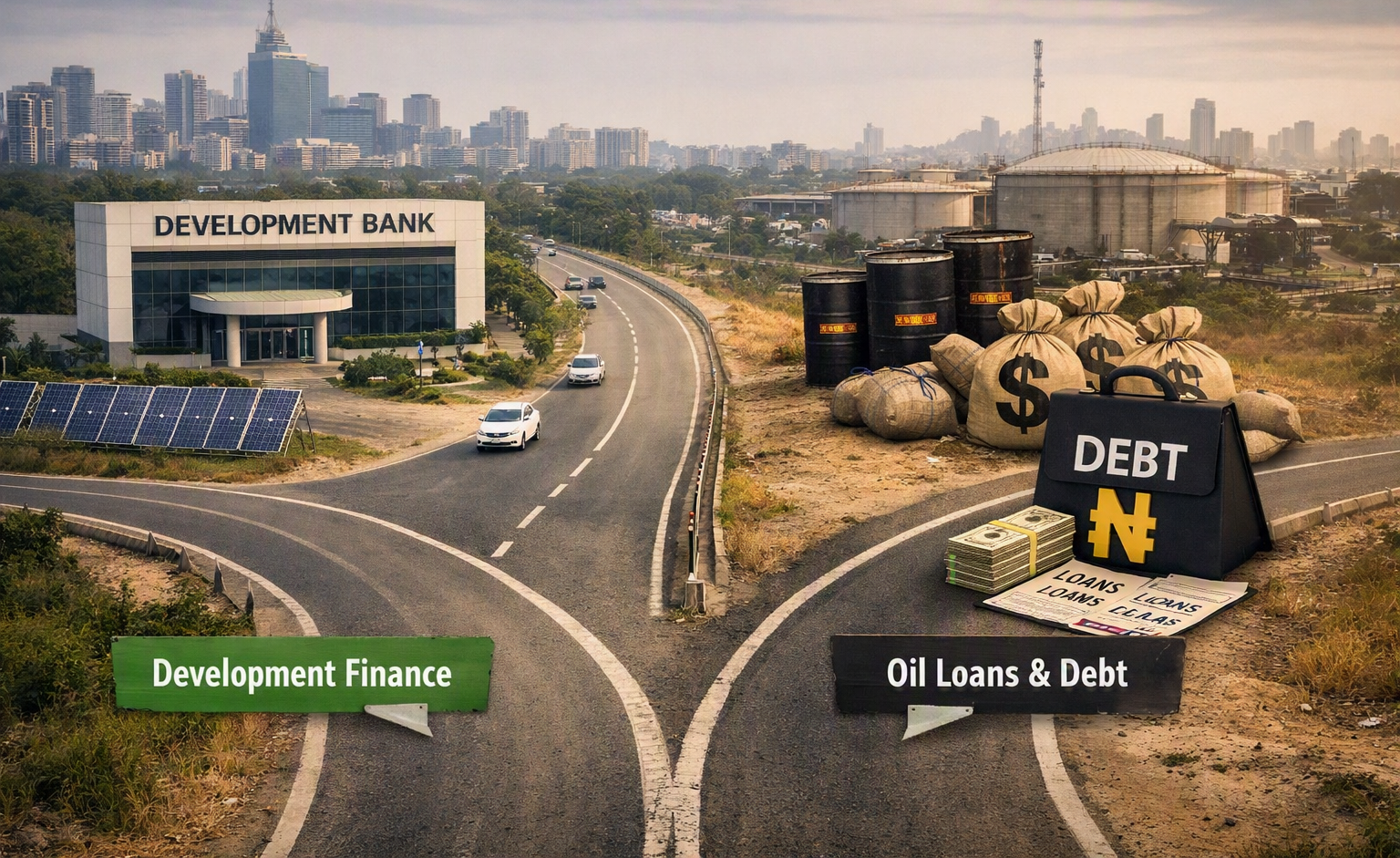
One is loud: a $4.5 billion oil-backed facility with NNPC approved in August, on top of a $5 billion total return swap with First Abu Dhabi Bank drawn down in phases since June — fast, large, sovereign-guaranteed borrowing that the IMF’s own resident representative has publicly warned carries “opaque” terms typical of derivatives-based structures. That’s the kind of capital that makes headlines because the number is big and the mechanism is unusual.
The other is quiet: a multi-year, still-unfinished rebuild of Nigeria’s entire domestic development finance architecture, running since January. It’s less dramatic. It’s also the one that actually determines whether Nigerian SMEs — not the federal government’s FX reserves — get financed over the next decade.
The Handover Nobody Noticed
On 1 January, the Federal Ministry of Finance announced it was taking over the “development finance quasi-fiscal responsibility” the Central Bank of Nigeria had held — and quietly stopped exercising two years earlier, when the CBN halted its direct funding of development programmes and left a real gap in long-term financing for infrastructure and energy.
Doris Uzoka-Anite, then Minister of State for Finance, framed the stakes in blunt fiscal terms: “Given the scale of Nigeria’s growth ambition and the need to crowd in long-term, patient capital estimated at ₦246 trillion through 2036, the Federal Government recognizes DFIs as essential partners in de-risking priority sectors, anchoring private sector investor confidence, and mobilizing large volumes of private capital at scale.”
Worth flagging plainly: that ₦246 trillion figure appears to originate only from Uzoka-Anite’s own statement and the Finance Ministry’s press materials repeating it. TACR could not locate a published study, World Bank estimate, or independent model behind the number. Treat it as a government projection stated in a policy announcement, not an externally verified figure.
Two institutions were named as the vehicles for that ambition: the Bank of Industry (BOI) and the Nigerian Export-Import Bank (NEXIM). The plan was a four-pronged one — better capitalisation, stronger governance with performance-linked boards, real risk-sharing powers like guarantees and first-loss tranches, and closer alignment with the Finance Ministry itself.
The Gap, Sourced Properly
Three months later, the CBN put a harder number on how far Nigeria’s DFIs are from that ambition.
Speaking at a panel session during the launch of the World Bank’s Nigeria Development Update in Abuja on 7 April, CBN Deputy Governor for Economic Policy Muhammad Sani Abdullahi disclosed that Nigeria’s MSME funding gap stands at more than ₦130 trillion — roughly 94.3billionatanimpliedconversionofabout₦1,378/1, consistent with where the naira was trading through the first half of 2026.
One correction worth making explicitly: that ₦130 trillion figure doesn’t come from the World Bank’s Nigeria Development Update document itself. The April 2026 edition of the NDU is titled “Nigeria’s Tomorrow Must Start Today” and focuses on early childhood development, not MSME financing. Abdullahi cited a separate, internal CBN review, telling reporters, “We conducted a review last year of the development finance space,” which found DFIs’ combined assets of just over ₦8 trillion “far below” actual SME financing needs. He used the NDU launch as the venue for the announcement, not the report as the source document.
That figure isn’t just a government talking point, though — it’s been independently corroborated. Dele Oye, chairman of the Alliance for Economic Research and Ethics, cited the same ₦130 trillion gap in a separate statement in May, affecting an estimated 39 million MSMEs, and called it evidence of a “structural failure” in Nigeria’s capital allocation system — a framing that didn’t originate with the CBN.
Do the arithmetic on ₦130 trillion against ₦8 trillion and the gap is more than sixteen times the size of the institutions meant to close it. That’s the number every subsequent DFI deal in Nigeria this year has to be measured against.
A Reform Announced By A Minister Who Then Changed Jobs
Here’s a detail that rarely makes it into coverage of the reform itself: Uzoka-Anite, who announced the DFI overhaul in January, moved to the Ministry of Budget and Economic Planning in March. Taiwo Oyedele stepped into Minister of State for Finance the same month, then became substantive Finance Minister by 21 April.
That’s two leadership transitions inside the finance ministry within four months of a multi-year DFI reform being announced. Nigeria’s broader macro reforms have shown real continuity across personnel changes so far, and Oyedele has publicly committed to the same $1 trillion economy framework Uzoka-Anite built. But a reform that depends on sustained institutional follow-through now depends on that continuity holding across a second finance minister in under a year.
NEXIM Was Named In January. It Needed Fixing Before That
NEXIM disappears from most coverage of the January reform almost immediately, which is a gap worth closing, because NEXIM’s own numbers explain exactly why it was named as a priority in the first place.
The bank’s statutory capital base sits at ₦50 billion — roughly $33 million. In November 2025, two months before the DFI reform was even announced, NEXIM’s own Managing Director, Abba Bello, told a Senate public hearing that figure was “grossly inadequate” to support Nigeria’s export ambitions under the African Continental Free Trade Area. The Senate responded by proposing the NEXIM (Amendment) Bill, 2025, which would raise the bank’s capital base to as much as ₦1 trillion — a twentyfold increase. Bello backed the proposal directly: “We fully support the proposal to raise the capital base to at least ₦500 billion, and ideally ₦1 trillion, to enable NEXIM to deliver on its mandate.”
That bill was still moving through the Senate committee process as of the November hearing, with no confirmed passage date found in NEXIM’s own public disclosures since. Unlike BOI, which had an AfDB facility land within five months of the January reform announcement, NEXIM’s own recapitalisation path runs through domestic legislation rather than an external DFI relationship — a slower, more politically contingent route, and one that hasn’t yet produced a comparable concrete milestone.
The First Real Capital To Show Up
Against that backdrop, the AfDB’s Board approved a $200 million financing facility for the Bank of Industry on 28 May — the first significant piece of external capital to land inside the reform architecture the January announcement described.
The facility is earmarked for medium- to long-term financing across infrastructure and transport, agro-food processing, health and pharmaceuticals, and green industrialisation, with at least 30% of proceeds required to benefit Nigerian SMEs specifically. It builds on an earlier $100 million AfDB line of credit to BOI that was fully repaid in 2025.
“This facility builds on BOI’s long-standing partnership with the African Development Bank, following the successful repayment of a previous $100 million line of credit in 2025,”said Olasupo Olusi, BOI’s Managing Director and CEO.
“We appreciate the Bank’s continued confidence in BOI’s mandate and institutional capacity.”Abdul Kamara, AfDB’s Director General for Nigeria, tied the approval directly to the DFI desk’s core logic: “Development finance institutions are critical for providing patient, long-term capital where commercial banks may be constrained.”
What $200 Million Actually Means Against $94 Billion
Read against the CBN’s own figure, $200 million is 0.2% of Nigeria’s MSME funding gap. That’s not a criticism of the deal — AfDB’s facility is real, it’s disciplined, and it’s aimed precisely at the sectors the January reform named as priorities.
It’s a scale check on the whole reform narrative. Nigeria’s DFI overhaul is structurally sound on paper: consolidate authority, recapitalise, add risk-sharing tools, align incentives. But the pace of external capital actually arriving — one $200 million facility to BOI in five months, no comparable milestone yet for NEXIM — moves far slower than the ₦246 trillion ambition Uzoka-Anite named in January, or the ₦130 trillion gap Abdullahi confirmed in April.
Dele Oye’s own assessment gets at exactly this gap between announcement and delivery. Beyond citing the ₦130 trillion figure, he named the specific institutions the reform is supposed to fix — BOI, the Bank of Agriculture, and NEXIM among them — and framed the real question as whether Nigeria’s government and its DFIs would actually undertake what he called “the technically demanding work of credit market reform,” rather than treat recapitalisation announcements as the finish line. That’s a sharper, more direct challenge to this specific reform than general commentary on Nigeria’s macro cycle would offer, and it’s independent of both the CBN and the Finance Ministry.
The real test isn’t whether AfDB or another DFI writes the next check. It’s whether the recapitalisation the CBN promised in April — actually increasing the ₦8 trillion base DFIs operate from, and actually moving NEXIM’s bill through the Senate — happens on a timeline that closes the gap rather than one more speech’s worth of it. Nigeria has shown this year it can move fast and big when the capital is sovereign-guaranteed oil money. Whether it can move with the same urgency on the slower, harder job of rebuilding the institutions meant to reach the businesses that oil money never touches is the open question the rest of 2026 will answer.
