

The Deal
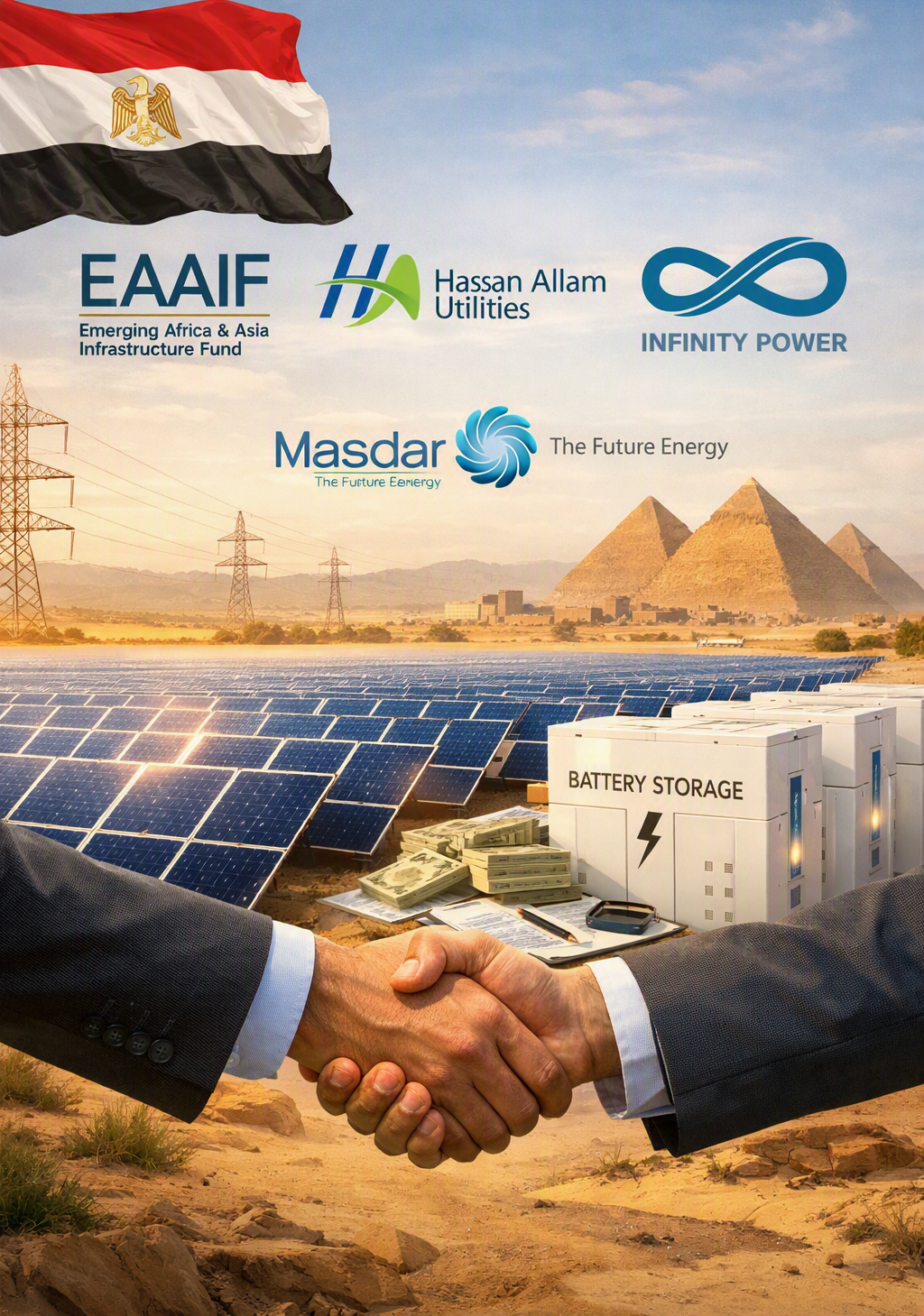
On 6 July, the Emerging Africa & Asia Infrastructure Fund (EAAIF) — a blended-finance vehicle under the UK-anchored Private Infrastructure Development Group, managed by Ninety One — committed a $30 million senior secured corporate loan to Hassan Allam Utilities, the investment arm of one of Egypt’s largest construction conglomerates. The money backs the Minya project: a 1,000 MW solar plant paired with a 660 MWh battery storage system, co-developed with Infinity Power, the Masdar–Infinity joint venture.
That $30 million sits on top of a $40 million facility EAAIF extended to the same developer in November 2024. Total EAAIF exposure to Hassan Allam Utilities: $70 million. EAAIF describes itself as “the sole lender with a primary claim in this transaction” — a single blended-finance fund holding first claim on a developer’s balance sheet, not a passive co-investment.
The Number Worth Sitting With
Total project cost for Minya runs to roughly $764 million. EAAIF’s $30 million is 4% of that. EBRD is separately weighing up to $170 million in senior debt for the same plant — a stake that would dwarf EAAIF’s by more than five to one.
The ownership structure explains why. Infinity Power Holding owns 51% of the project vehicle. The remaining 49% runs through HAU Energy, a platform established in 2024 and co-owned by Hassan Allam Utilities, EBRD, and French infrastructure investor Meridiam. One European development bank sits on both the equity side and the prospective debt side of the same asset.
What Inconsistent Specs Actually Reveal
Reporting on this single project doesn’t agree on basic specifications, and the disagreement is precise enough to argue something rather than just note it. EAAIF and Hassan Allam describe Minya as 1,000 MW of solar with 660 MWh of storage. Infinity Power’s own PPA announcement gives the same asset as 1,000 MW with 600 MWh. EnterpriseAM’s own reporting — the single outlet covering this relationship most closely — states elsewhere that Minya and Benban combined total 720 MWh of storage. Add EAAIF’s 660 MWh Minya figure to Benban’s confirmed 120 MWh and you get 780, not 720. The only way to reach 720 is to use the 600 MWh version of Minya instead.
That’s not a rounding error or a translation artifact. It’s evidence that even the trade outlet tracking this relationship most closely couldn’t hold one consistent figure for the same plant across its own coverage — which means the underlying project specifications were still moving after EAAIF, EBRD, and Infinity Power had each already put figures into public disclosures tied to real capital commitments. For a sector now absorbing hundreds of millions of dollars in DFI financing on the strength of project-level disclosures, that’s a real gap between how firm these numbers sound in a press release and how firm they actually are on the ground. Expect the figures to keep moving across future announcements, and expect any single number cited here to need a recheck against the closest disclosure to actual financial close.
Two Institutions, The Same Word
EBRD’s own Director of Sustainable Infrastructure for the Middle East and Africa, Aida Sitdikova, put it directly when EBRD backed HAU Energy’s Benban project in April: “We are extending our partnership with Meridiam and HAU, whose commitment to high standards are instrumental in delivering projects of such impact.” Ninety One’s Martijn Proos, on the EAAIF side, used almost identical language announcing the Minya facility months later and on a different deal: “the expansion of our partnership with Hassan Allam Utilities.”
Neither institution called this new origination. Both called it partnership expansion — the same word, from two separate lenders, on two separate transactions, months apart.
That confirms the mechanism this piece is arguing rather than just observing it. Consolidation isn’t an accidental side effect of how DFI capital moves in frontier markets — the institutions doing it are naming it as strategy.
The Pattern This Fits Into
Minya sits under the EBRD-led Energy Pillar of Egypt’s Nexus of Water, Food and Energy programme, targeting 10 GW of new renewable capacity by 2028. EBRD’s own 2026 Egypt commitment runs to $1.4–1.5 billion, with up to $600 million earmarked specifically for green projects — a figure EBRD’s Hashem Abd El Hakim, the bank’s deputy head of Egypt for financial institutions, gave directly to EnterpriseAM in April and which the outlet has repeated in its coverage of subsequent EBRD deals through July, attributed to the same named source each time. Worth flagging plainly: TACR checked EBRD’s own Green Economy Transition Strategy 2026-30 and its Egypt country strategy documentation for a primary source on the Egypt-specific $600 million figure and found neither one contains it. What those documents do confirm, at the institutional level: EBRD’s global 2026-30 strategy commits to at least 50% of its total annual business volume going toward green investments, part of a €150 billion cumulative green-financing target. The $600 million Egypt figure remains sourced only to Abd El Hakim’s on-record statements as reported by EnterpriseAM — real, consistently attributed, but not yet codified in a document TACR could independently verify.
Hassan Allam’s relationship with EBRD now spans well beyond Minya and Benban. In December 2025, EBRD approved a separate $25 million loan to modernise equipment at Hassan Allam Construction, a different subsidiary entirely. The HAU Energy platform overall — per its own recent PPA announcements — now represents roughly $3.5 billion in combined investment across 2.3 GW under development and a further 1.65 GW pipeline.
What This Means For The DFI Desk
Read on its own, $30 million is a modest line item. Read against the full picture — EAAIF’s expanding exposure, EBRD’s prospective $170 million, a separate $25 million construction-equipment loan, and two lenders independently describing their own capital as “partnership expansion” rather than new origination — the picture is DFI capital consolidating deliberately around one proven Egyptian developer relationship rather than spreading across a broader base of first-time sponsors.
Whether that concentration accelerates Egypt’s 2030 renewable target or simply crowds financing toward whoever already has the relationships is the open question worth tracking as EBRD’s prospective $170 million for Minya either closes or doesn’t.
