

For Mali, financial sovereignty is becoming less a slogan than a question of plumbing: who holds the money, who decides where it goes, and who can still interrupt the flow? That is the logic behind the Alliance of Sahel States’ (AES) push to build its own financial institutions after Mali, Burkina Faso and Niger broke with ECOWAS. The most consequential piece is no longer the political declaration. It is the attempt to create a regional balance sheet that can collect public resources and recycle them into roads, power, irrigation, industry and security-linked infrastructure.
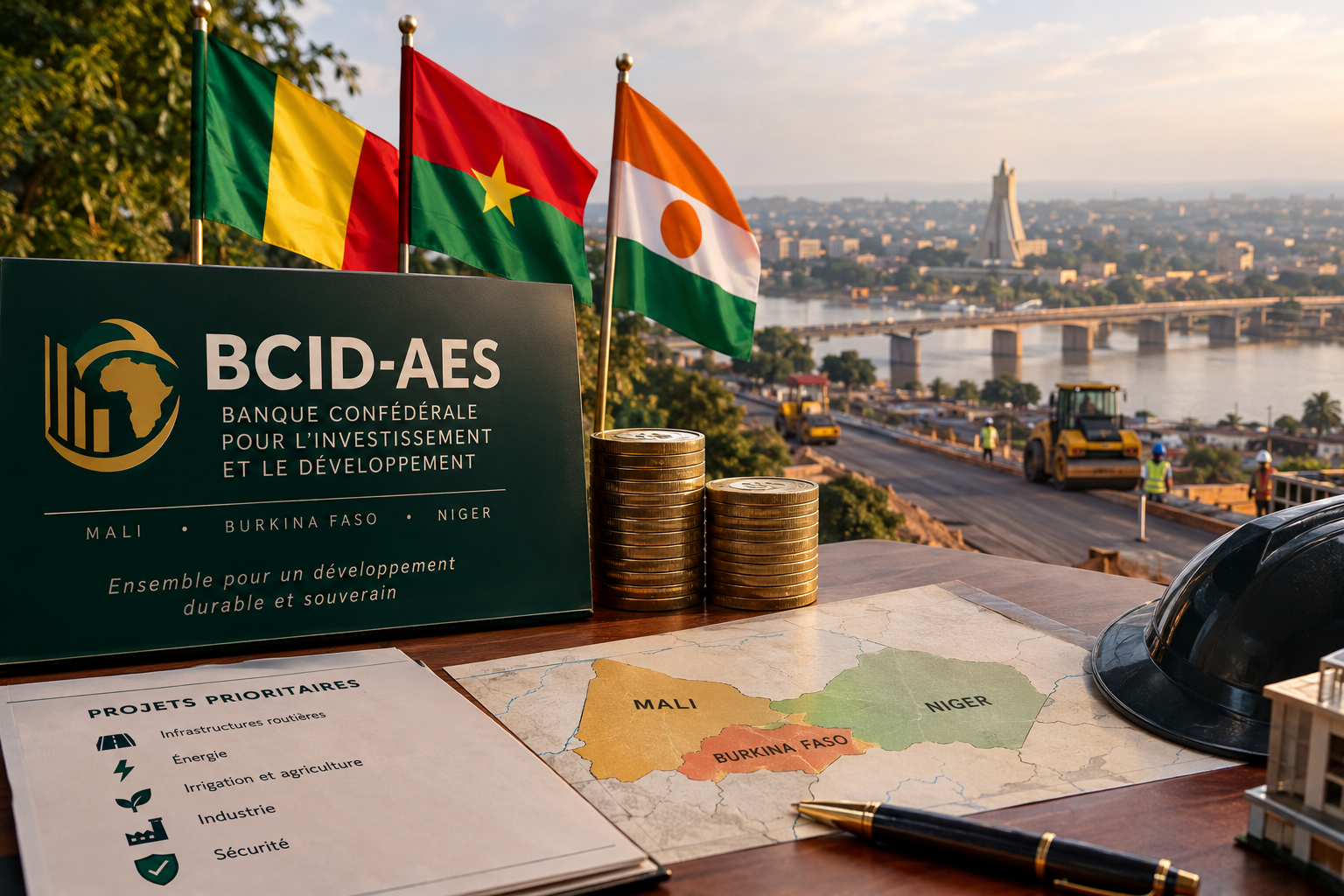
The centrepiece is the Banque Confédérale pour l’Investissement et le Développement (BCID-AES), inaugurated in Bamako in December 2025 with an initial capital of CFAF 500 billion. The three governments say the bank will mobilise sovereign resources for roads and connectivity, agriculture and food security, energy and regional interconnections, and private-sector projects.
Mali’s finance minister, Alousseni Sanou, described its creation as “an act of political importance” and a signal of the three countries’ commitment to financial sovereignty.
That distinction matters. The AES is not yet financially autonomous. Mali remains inside the West African Monetary Union (WAMU), whose common currency is the CFA franc issued by the BCEAO, and the BCEAO manages the official foreign-exchange reserves of its member states. The IMF’s 2025 assessment also assumed Mali, Burkina Faso and Niger would remain bound by WAEMU obligations after leaving ECOWAS. In other words, the immediate strategy is not to switch off the existing monetary system; it is to build a parallel development-finance layer underneath it.
From Reserve Control To Capital Allocation
The real prize is control over allocation. A country can have reserves and still have little freedom over what its financial system prioritises if its borrowing costs, liquidity conditions and access to regional markets are determined elsewhere. The BCID-AES gives the three governments a vehicle through which public money can be pooled, lent and invested according to AES priorities, rather than relying entirely on commercial banks or external development financiers.
Mali’s recent debt experience shows why that matters. IMF data indicate that regional financing conditions tightened sharply in 2023–24, with some Malian bond issues undersubscribed and three-year borrowing costs rising above 8%. Domestic banks became major underwriters, increasing what the IMF calls the bank-sovereign nexus: the government depends on banks for financing while banks accumulate government exposure.
A confederal investment bank could eventually change that structure by becoming another buyer, lender or project-finance intermediary — although its actual lending capacity will depend on how much of the CFAF 500 billion is paid in, how it raises additional capital and how its credit risk is managed.
A CFAF 500 billion authorised capital is not the same thing as CFAF 500 billion available for projects. The governments have said capital will be released progressively, and Mali’s finance minister said in January 2026 that the first funds had already been paid in. Public information, however, does not yet provide a full, independently verifiable breakdown of paid-in capital by country, the bank’s leverage target, its pipeline of approved projects or its lending terms. Those gaps make it premature to describe BCID-AES as a substitute for the BCEAO or for international development banks.
The Infrastructure Test
Mali’s development needs are visible in projects that already exist but remain dependent on outside capital. The Office du Niger, one of West Africa’s largest irrigation systems, draws water from the Niger River and is central to Mali’s attempt to turn agricultural land into food security and export capacity. A 2025 irrigation programme in the Bani basin and at Sélingué was budgeted at CFAF 47.4 billion, including CFAF 30 billion from BOAD.
Its first phase had already delivered 36,500 hectares of hydro-agricultural development and was estimated to have added more than 61,000 tonnes of paddy rice annually, alongside vegetables, fish and livestock production.
The sovereignty question is therefore straightforward: can an AES institution eventually finance the next irrigation canal, feeder road, power connection or agro-processing plant from regional resources, while keeping the resulting revenues and procurement chains more firmly inside the bloc? That would turn sovereignty from a monetary slogan into a capital-recycling system. It would also create a bigger market for Malian contractors, farmers, transport operators and processors, provided the bank’s lending is commercially disciplined rather than simply politically directed.
The same logic is visible in gold. Mali broke ground in June 2025 on a national gold refinery designed for up to 200 tonnes a year, with the state holding a 62% stake in the project. The objective is to move more of the value chain inside Mali instead of exporting an unprocessed resource. For the AES financial project, this is the missing link: if greater state participation raises domestic fiscal receipts, those receipts can theoretically become part of the capital base available for infrastructure and industrial investment. The challenge is proving that the additional value will actually be captured by the public balance sheet and then reinvested productively.
A Hedge Against External Financial Pressure — Not An Escape Yet
Mali remains subject to targeted US sanctions authorities, including asset-blocking measures against designated persons, while the wider Sahel governments have increasingly sought financing channels less exposed to Western political leverage. But the BCID-AES does not make sanctions irrelevant. Its effectiveness against external financial pressure will depend on whether it can mobilise hard currency, maintain correspondent banking relationships, access international payment systems and attract investors beyond the three governments.
Nor has the AES launched a new currency. Claims circulating online that the bloc had already introduced a currency were false. The three states have discussed monetary sovereignty and the possibility of a common currency, but the existing CFA franc remains their legal tender. A future currency would require much more than printing notes: the bloc would need a credible central-bank framework, reserve policy, payment infrastructure, fiscal rules and a mechanism for managing exchange-rate risk. BCID-AES may help build the financial institutions needed for that ambition, but it is not itself a central bank.
The Real Gamble Is Governance
The AES is effectively trying to change the direction of the money pipeline before changing the currency running through it. That is a more pragmatic strategy than an overnight monetary break. But it also concentrates a large amount of financial discretion in institutions whose governance, disclosure and risk-management systems are still being built.
For investors, the question is therefore not whether the BCID-AES sounds sovereign. It is whether it can become bankable. The market will eventually want to know who takes first-loss risk, how projects are selected, whether procurement is competitive, what collateral is accepted, how losses are shared between the three states, and whether the bank can raise money without turning sovereign politics into credit risk.
If those mechanisms work, Mali could gradually move from being mainly a borrower inside a regional monetary system to being an anchor of a regional capital-allocation system. If they do not, the AES may simply reproduce the same dependence it is trying to escape, only with a new institution and a new political vocabulary.
