


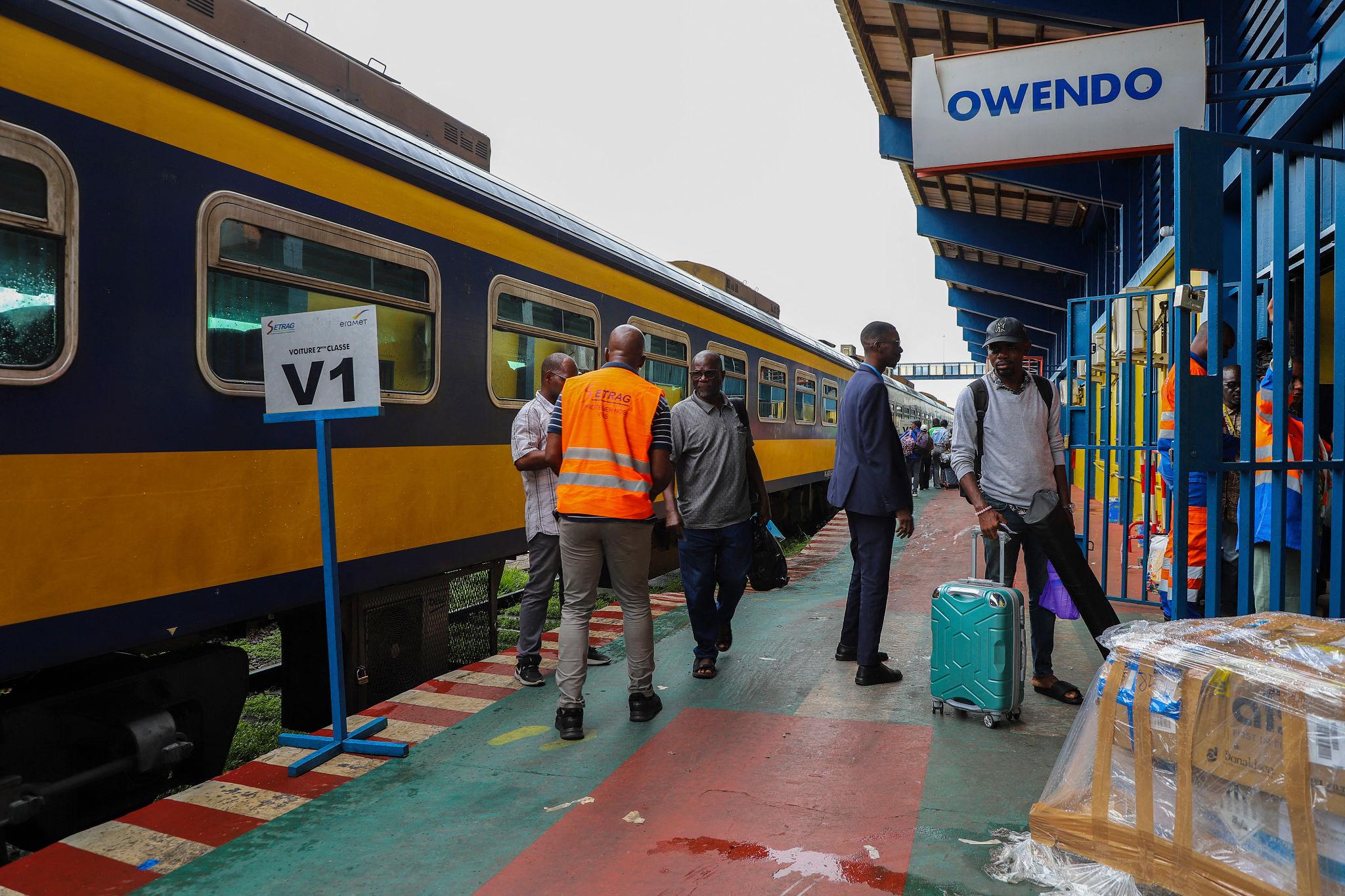
A €312 million financing package for Gabon’s Trans-Gabon Railway shows how development finance can make a difficult infrastructure asset investable without making the underlying sovereign risk disappear.
The lenders did not make Gabon’s political risk disappear. They moved different parts of it onto different balance sheets.
That is the more interesting story behind the €312 million financing agreement signed by Proparco, the International Finance Corporation (IFC) and Société d’Exploitation du Transgabonais (SETRAG) in July.
The package comprises €225 million of new financing and €87 million of refinancing for the railway’s Phase III modernisation programme. SETRAG, rather than the Gabonese government, is the borrower on the private-side financing. IFC’s public project record identifies the transaction as SETRAG III, Project ID 49419.
The timing matters. Gabon has spent the period since the August 2023 coup rebuilding its institutions while confronting significant financing needs. Moody’s moved Gabon’s sovereign outlook to negative in June 2026, citing funding pressures and restricted access to financing.
Yet the railway financing moved ahead.
The reason is visible in the structure.
The €312 Million Is Not A Sovereign Bet
SETRAG operates Gabon’s only railway, a 648-kilometre freight and passenger network, under a concession that runs to 2045.
Its shareholders are Compagnie Minière de l’Ogooué (Comilog), part of French mining group Eramet, with 51%; infrastructure investor Meridiam with 40%; and the Gabonese government with 9%. The railway connects the Port of Owendo on the Atlantic coast with Franceville in the country’s interior and carries manganese, other freight and passengers.
That gives the lenders something different from a straightforward sovereign credit exposure: a private operating company, a long-dated concession and identifiable commercial demand.
The railway is also strategically difficult to replace. Comilog’s manganese operations depend on the line to move ore from Moanda to the port, while the railway serves other industrial customers and passengers.
The financing is therefore tied to an operating asset with its own commercial activity and contractual rights.
But that does not eliminate political risk.
It changes where the risk sits.
The Transition Did Not Unwind The Concession
This is the sovereign-risk variable investors are likely to focus on.
When General Brice Clotaire Oligui Nguema and the military took power in August 2023, Eramet temporarily suspended operations at its Gabonese sites, including the railway, before progressively restarting them as the situation stabilised.
The transition authorities subsequently treated the railway as strategic infrastructure rather than seeking to dismantle the existing SETRAG concession. Eramet continued to engage directly with Oligui Nguema during the transition, including at industrial sites operated by Comilog, while SETRAG continued operating the national railway under its concession.
The relationship matters because the transition government’s broader economic approach was more interventionist than that of the previous administration. It pursued greater state participation and local value capture in strategic sectors, including mining and petroleum.
Yet the SETRAG structure remained intact: Comilog retained its 51% position, Meridiam retained 40%, and the state retained its 9% stake. The concession itself remained the contractual framework governing the railway.
That does not make the sovereign risk negligible. It provides investors with something more useful: evidence of how the new authorities have treated an existing strategic concession when given the opportunity to change the economic relationship.
So far, the signal has been continuity rather than concession cancellation.
That continuity is part of the underwriting case.
The Public And Private Financing Are Deliberately Separated
The wider Phase III modernisation programme is much larger than the €312 million headline.
IFC’s project disclosure puts the total Phase III programme at up to €799 million. Up to €704 million is allocated to rehabilitation, with €501 million attributed to SETRAG-funded works and €203 million to State-funded works. A further €95 million is allocated to refinancing part of SETRAG’s outstanding debt.
The financing follows that division of responsibility.
SETRAG is responsible for the railway superstructure and operational systems, while the Gabonese State remains responsible for public infrastructure such as bridges, hydraulic infrastructure and passenger transport equipment.
The State’s €203 million component is financed separately.
AFD’s own project record identifies a €173 million sovereign loan to the Republic of Gabon for the programme. AFD’s transport activity report identifies the public financing as €173 million of AFD sovereign financing plus a €30 million EU-delegated grant.
Those funds are not part of the €312 million SETRAG financing package. They support the government’s share of the railway works.
That distinction matters because the transaction does not ask the same lender to price the sovereign and commercial components as if they were one risk.
IFC Is Using Its Balance Sheet To Bring In Other Capital
IFC’s role is broader than providing a loan.
Its public disclosure for SETRAG III, Project ID 49419 separates IFC’s own approved exposure from the wider financing it is arranging alongside other lenders, including capital mobilised through the Managed Co-Lending Portfolio Program.
The structure matters because MCPP allows institutional investors to participate alongside IFC in emerging-market projects. The mechanism effectively allows IFC to use its origination, due diligence and structuring role to bring additional capital into a transaction.
IFC is also providing interest-rate risk-management support through swaps as part of the financing structure.
This is another layer of risk separation.
The project risk is not sitting entirely on SETRAG, IFC or one commercial lender.
It is distributed.
The Lenders Are Buying A Track Record, Too
SETRAG is not a new IFC or Proparco relationship.
Earlier phases of the railway rehabilitation programme were financed with development-finance participation, and the current transaction extends that financing relationship.
That history matters because the lenders have had visibility into the concession, the operator and the rehabilitation programme.
SETRAG CEO Christian Magni described the latest financing as reflecting lenders’ confidence in the company’s “business model and operational trajectory.”
Proparco CEO Françoise Lombard similarly framed the investment around the role of reliable transport infrastructure in private-sector development, regional competitiveness and job creation.
The institutional message is straightforward: the lenders are not underwriting an unknown railway in an unknown operating environment.
They are financing the next stage of an asset they have already had exposure to.
But The Commercial Concentration Is Hard To Ignore
There is a weakness in the commercial case, and it is visible in the freight numbers.
SETRAG transported 8.9 million tonnes of freight in 2024, of which 8.4 million tonnes were mining products. That means roughly 94% of the reported freight volume was mining-related.
For a railway investor, that concentration cuts both ways.
It creates a powerful anchor customer base. Gabon’s manganese industry provides the volume that makes the corridor economically viable.
But it also means railway utilisation is closely tied to the health and operating continuity of the mining sector.
Eramet’s own description of the network makes clear how central the railway is to Comilog’s value chain: SETRAG transports Comilog’s manganese ore as well as other raw materials and passengers. Eramet has also acknowledged that the railway was originally designed for roughly one-tenth of today’s traffic, while Gabon’s tropical conditions create persistent maintenance challenges.
That changes the way to think about the modernization programme.
The investment is not simply adding capacity to chase future demand.
It is repairing and strengthening a corridor that is already carrying traffic well above the level for which it was originally designed.
Comilog itself describes rail as the system through which more than six million tonnes of ore and other goods are moved annually to Owendo.
So the commercial underwriting rests partly on a simple proposition: the railway is not looking for a market; the market is already using the railway.
The investment challenge is keeping that corridor reliable enough to serve it.
MIGA Is Taking A Different Part Of The Risk
The political-risk architecture extends beyond the debt.
Meridiam’s 40% equity position in SETRAG is supported by the Multilateral Investment Guarantee Agency (MIGA). MIGA’s project disclosure provides political-risk protection around the investment, including specified risks such as transfer restriction and inconvertibility, expropriation, war and civil disturbance, and breach of contract.
That is a different instrument for a different risk.
A lender worries about repayment.
An equity investor also worries about what happens to the investment if political events interfere with the concession or the ability to move capital.
MIGA’s guarantee does not remove those events from the investment case. It provides protection against defined political risks if they occur.
And the underlying concession runs until 2045.
That gives SETRAG and its shareholders a long contractual horizon over which to deploy capital in a capital-intensive railway, while MIGA provides protection around defined political risks attached to the private investment.
The structure is therefore doing something quite specific.
The Gabonese State takes responsibility for the public infrastructure component, supported by AFD and EU funding.
SETRAG finances and operates the commercial railway component.
IFC anchors and mobilises debt capital.
Proparco participates alongside it.
MCPP brings additional institutional capital into the financing structure.
MIGA protects Meridiam against defined political risks.
And the 2045 concession provides the long-term operating horizon around private investment.
The risk has not been removed. It has been allocated.
