


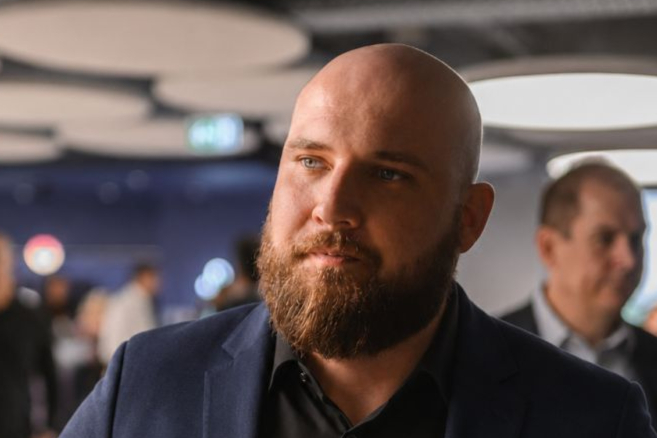
Source: Angel’s Lounge, a Lagos Angel Network interview series, hosted by Solomon King. Guest: Arturas Svirskis, CEO of Fintexus and Hexagon Ventures Group, Kaunas, Lithuania. Interview conducted March 3, 2026. Watch: youtu.be/rCZEIZ26qng, titled “Arturas Svirskis on Fintech, Crypto, and Angel Investing in Africa & Other Emerging Markets.”
There’s a particular kind of investor conversation that only makes sense once you strip away the geography. On Angel’s Lounge, the Lagos Angel Network’s interview series on the voices shaping capital across the continent, host Solomon King sat down with an angel investor calling in from Kaunas, Lithuania — a man twelve years deep in fintech and crypto, several accelerator mentorships into his career, and, by his own count, still a relative beginner in the world of writing cheques.
His name is Arturas Svirskis. He has one African country stamped in his passport. He has a Nigerian company in his portfolio anyway.
That contradiction is the whole story.
Twelve Years in the Rails Before the First Cheque
Svirskis didn’t arrive at angel investing through a windfall or a single lucky exit. He arrived through a decade of proximity — building a career inside fintech since 2014, advising regulated crypto and fintech businesses on licensing, mentoring founders across five accelerators split between the UAE and the crypto ecosystem, and running a consulting practice on the side that does the unglamorous work of growth: user acquisition, revenue, business development.
By the time he wrote his first cheque in 2017, into a crowdfunding platform operating inside the tightening rules of EU fintech regulation, he wasn’t stepping into a new world. He was formalising one he already lived in.
That distinction matters. It produced the line of the conversation. Asked how he operates as an investor, Svirskis said it plainly:
“It’s not that I give money and then I step aside and watch how you work… basically I pay money to have the possibility to work.”
Not a cheque-and-wait investor. Someone who buys their way into the work.
King pushed back gently on the framing — there’s a line, he noted, between being embedded like a team member and slipping into micromanagement. Svirskis agreed. The difference, in his telling, is alignment: when a founder’s vision and an angel’s instincts point the same direction, being close to the business is fuel. When they don’t, it’s friction dressed up as diligence.
The Portfolio Math: Five Companies, One Continent Away
Svirskis describes his portfolio — five-plus companies — as “baby steps.” Modest, in his own assessment. But scattered across geographies and industries deliberately, as a way of managing risk he can’t fully see from Kaunas. Somewhere in that portfolio sits a Nigerian crypto business, backed in what he calls the “triple F” stage — friends, family, and fools — except he’s neither friend nor family to the founders.
“Probably I’m the fool,” he offered, half self-deprecating, half testing the room.
King’s response was sharper than a compliment: not a fool, a fan. An investor who saw Nigerian founders building for Nigerians — a passive-income crypto product aimed at local users navigating a market where day trading mostly ends in losses — and decided the thesis was sound even without ever having met the market in person.
The structure of the deal tells you how he manages that distance. The investment is KPI-based; capital scales with results. It’s a hedge against the thing every cross-border angel fears most: writing a cheque into a market you can’t read the room in, then hoping the read was right.
He’s also not as unusual as he sounds. The ABAN 2025 Angel Investment Survey Report — produced by the African Business Angel Network with the UN Development Programme and Japan’s Ministry of Foreign Affairs, drawing on Briter Intelligence’s deal-tracking data — found that diaspora and cross-border angels account for roughly 270 of the more than 620 announced angel deals recorded across the continent over the past decade: 60 percent of all tracked angel investment activity, even though only about a third of individual angels surveyed self-identify as diaspora investors. Svirskis isn’t an anomaly. He’s one data point inside a cohort that’s already doing a disproportionate share of the continent’s early-stage cheque-writing.
A Thesis Built on Catching Up, Not Copying
Ask Svirskis why Africa, and the answer isn’t romantic. It’s structural.
Europe, he argues, is spoiled — saturated with fintech unicorns and consumer products like Revolut that have already solved the problems worth solving. There’s no frontier left to build on. Emerging markets, Africa included, still have that frontier. His stated goal isn’t to import Europe wholesale — he’s explicit that copy-paste doesn’t work — but to bring patterns and execution discipline to markets that are, in his words, a few steps behind and closing the gap fast.
There’s also a quieter motive underneath the strategic one: proximity to conflict. Lithuania sits close enough to the Russia-Ukraine war that geopolitical risk isn’t an abstraction for him — it’s a reason to diversify capital outward, toward markets less tangled in Europe’s fault lines.
Two forces, one direction: opportunity pulling him toward Africa, risk pushing him away from home.
The Diligence Filter: Team, Focus, and a Warning About Greed
Pressed on how he actually picks companies, Svirskis reached for a line he heard eight years ago at Startup Wise Guys, one of Europe’s larger B2B accelerators — that the three most important things in a startup are the team, the team, and the team — and then did the more useful thing: he explained what that means when money is on the line.
He checks whether founders have direct, lived experience in the problem they’re solving. He checks for focus, and he’s wary of founders juggling multiple ventures at once, because early-stage traction demands a single-mindedness that split attention can’t deliver.
Then he named something sharper: a mentality he’s learned to avoid, particularly common in crypto, where founders chase the largest possible raise without regard for their cap table or the rounds that come after — greed-driven, as opposed to purpose-driven, where a founder would rather raise a smaller round now, build real traction, and come back for a bigger round at a better valuation later.
It’s a distinction that should sound familiar to anyone who has watched African startups raise too much, too early, on too little proof.
On whether founders can learn on an investor’s dime — pivoting their way to product-market fit using someone else’s capital — Svirskis didn’t give a clean answer, because there isn’t one. But his sharper point is one he says he’s made on LinkedIn before, and he restated it almost verbatim on the show:
“Investments just amplify what you have at the moment. If there is the mess in the company, the extra capital just amplifies the mess in the company.”
New money doesn’t fix bad processes or an unclear path to customers. It makes whatever is already there — good or broken — bigger, faster.
Bootstrapping Fintech: A Claim Worth Checking, Not Just Repeating
Asked whether fintech founders in Africa can bootstrap without ever raising, Svirskis pointed to progress he’s tracked in Kenya and named a Nigerian company he called “Dabba Finance” — while admitting he’s still learning the market. That reference doesn’t hold up: the closest match, Daba Finance, is an Ivorian-founded, venture-backed platform (African Business; Tracxn), not a bootstrapped Nigerian success story — a plausible mishearing on a cross-continental call, but not a claim TACR can repeat as stated.
The underlying point still holds elsewhere: Raphael Obodugo bootstrapped MySub to over 360,000 users and roughly $6,700 in monthly recurring revenue with no outside capital, per TTYBrand Africa — proof that founder-funded traction is possible in Nigerian fintech, even if the company Svirskis actually named wasn’t it. No comparably verified Kenyan example surfaced, so that half of his claim stays unconfirmed rather than repeated as fact.
Why He’s Joining Lagos Angel Network
Svirskis framed his reasons for joining LAN in two parts, and neither was about deal flow in the way most people mean it.
The first was access — not to the most polished startups, but to a clearer read of the Nigerian ecosystem than he can get from outside it. The second was co-investment as risk mitigation: more minds on a deal, more perspectives stress-testing a thesis before capital moves.
But the real thread running under both was patience. Twelve years into building his network, he offered something easy to nod along to and hard to actually practise:
“I’m not chasing fast revenues. I’m here to make friends, deep connection — and it’s not about money, but it is about the inner passion of creating value. Money comes sooner or later.”
The takeaway for TACR readers: For Nigerian founders courting cross-border capital, the operating lesson isn’t to find investors who already understand the market — it’s to structure the round, with KPI-linked tranches, staged capital, and provable unit economics, so that an investor who doesn’t yet understand the market can still say yes.
Editorial note: Identity, city, and interview date are confirmed — directly by Solomon King and independently corroborated across LinkedIn, F6S, and Crunchbase: Arturas Svirskis, CEO of Fintexus and Hexagon Ventures Group, Kaunas; interview conducted March 3, 2026.
